Ace - AI Tutor
Ask Our Educators
Textbooks
My Library
Flashcards
Scribe - AI Notes
Notes & Exams
Download App
Tommie Tommie

Tommie T.

Divider

Questions asked

INSTANT ANSWER

APPLY Experiment 17: Grignard Reaction Two Questions - Please answer the following questions. Limited partial credit will be given for the questions. 1) Below are the \( { }^{1} \mathrm{H} \) NMR spectrum of triphenylmethanol, benzophenone, and bromobenzene. Identify the compound corresponding to each \( { }^{1} \mathrm{H} \) NMR spectrum and draw the structure next to the \( { }^{1} \mathrm{H} \) NMR spectrum. Assign ALL peaks in each of the three \( { }^{1} \mathrm{H} \) NMR spectra. Hint: Conjugated systems including an electronegative atom will cause a more downfield shift of ring protons in \( { }^{1} \mathrm{H} \) NMR.

View Answer
divider
INSTANT ANSWER

APPLY Experiment 17: Grignard Reaction Two Questions - Please answer the following questions. Limited partial credit will be given for the questions. 1) Below are the \( { }^{1} \mathrm{H} \) NMR spectrum of triphenylmethanol, benzophenone, and bromobenzene. Identify the compound corresponding to each \( { }^{1} \mathrm{H} \) NMR spectrum and draw the structure next to the \( { }^{1} \mathrm{H} \) NMR spectrum. Assign ALL peaks in each of the three \( { }^{1} \mathrm{H} \) NMR spectra. Hint: Conjugated systems including an electronegative atom will cause a more downfield shift of ring protons in \( { }^{1} \mathrm{H} \) NMR.

View Answer
divider
INSTANT ANSWER

4) What are three methods you used in this experiment to keep the reaction water free and ensure that the Grignard Reagent is formed successfully?

View Answer
divider
INSTANT ANSWER

Questions - Please answer the following questions. Limited partial credit will be given for the questions. 1) Draw the potential byproducts that could have formed from phenyl magnesium bromide reaction with (1) water and (2) carbon dioxide. 2) What would happen if a student added \( 5 \% \) aqueous \( \mathrm{NaHCO}_{3} \) instead of 6 M HCl in the hydrolysis step? What, if anything, could be done to correct this error? Could the product still be isolated? Explain your answer. \( \xrightarrow{\left(\mathrm{H}_{2} \mathrm{O}\right.} \) 3) A student had a mixture of the following byproducts of a Grignard synthesis. How could these two compounds be separated and isolated as solids using ether, water, acetone, \( 5 \% \) aqueous \( \mathrm{HCl}, 5 \% \) aqueous \( \mathrm{NaHCO}_{3} \) and anhydrous sodium sulfate. Give step by step instructions. UNIVERSITYATALBANY State University of New York

View Answer
divider
INSTANT ANSWER

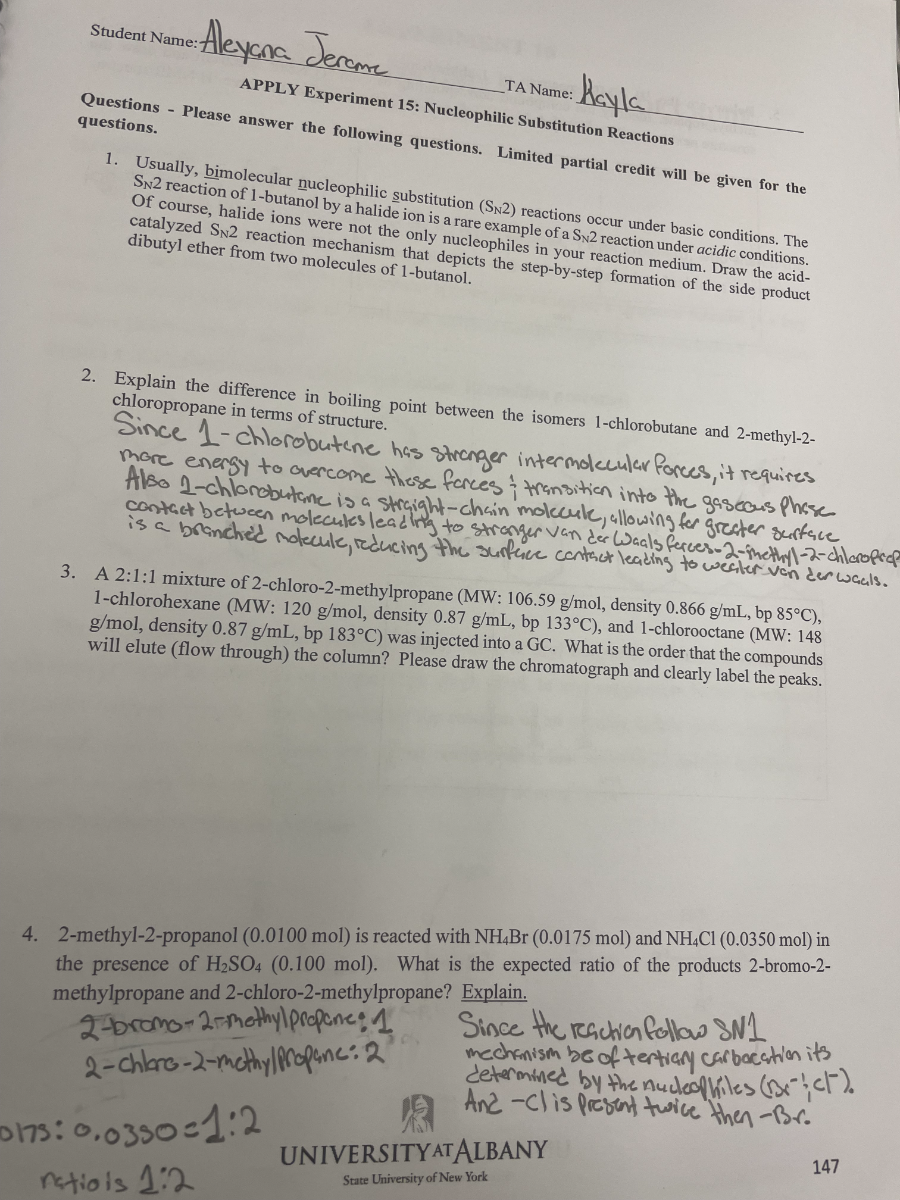
Student Name: Aleycna Jerame APPLY Experiment 15: Nucleophilic Substitution Reactions Questions - Please answer the following questions. Limited partial credit will be given for the questions. 1. Usually, bimolecular nucleophilic substitution \( \left(\mathrm{S}_{\mathrm{N}} 2\right) \) reactions occur under basic conditions. The \( \mathrm{S}_{\mathrm{N}} 2 \) reaction of 1-butanol by a halide ion is a rare example of a \( \mathrm{S}_{\mathrm{N}} 2 \) reaction under acidic conditions. Of course, halide ions were not the only nucleophiles in your reaction medium. Draw the acidcatalyzed \( \mathrm{S}_{\mathrm{N}} 2 \) reaction mechans molecules of 1-butanol. dibutyl ether from two molecules of 1-butanol. 2. Explain the difference in boiling point between the isomers 1-chlorobutane and 2-methyl-2chloropropane in terms of structure. Since 1-chlorobutane has stranger intermolccular forces, it requires more energy to overcome these farces 1 transition into the gaseous phese Also 1-chlonobutane is a straight-chain molecule, allowing for grecter sarface is a branched motecule, reducing the surface contact leading to weater von der wails. 3. A \( 2: 1: 1 \) mixture of 2-chloro-2-methylpropane (MW: \( 106.59 \mathrm{~g} / \mathrm{mol} \), density \( 0.866 \mathrm{~g} / \mathrm{mL}, \mathrm{bp} 85^{\circ} \mathrm{C} \) ), 1-chlorohexane (MW: \( 120 \mathrm{~g} / \mathrm{mol} \), density \( 0.87 \mathrm{~g} / \mathrm{mL} \), bp \( 133^{\circ} \mathrm{C} \) ), and 1-chlorooctane (MW: 148 \( \mathrm{g} / \mathrm{mol} \), density \( 0.87 \mathrm{~g} / \mathrm{mL} \), bp \( 183^{\circ} \mathrm{C} \) ) was injected into a GC. What is the order that the compounds will elute (flow through) the column? Please draw the chromatograph and clearly label the peaks. 4. 2-methyl-2-propanol \( (0.0100 \mathrm{~mol}) \) is reacted with \( \mathrm{NH}_{4} \mathrm{Br}(0.0175 \mathrm{~mol}) \) and \( \mathrm{NH}_{4} \mathrm{Cl}(0.0350 \mathrm{~mol}) \) in the presence of \( \mathrm{H}_{2} \mathrm{SO}_{4}(0.100 \mathrm{~mol}) \). What is the expected ratio of the products 2-bromo-2methylpropane and 2-chloro-2-methylpropane? Explain. 2-bromo-2-methylpropane: 1 Since the recction follow SN1 2-chlore-2-mcthy|propanc: 2 mectrnism be of tertiany carbocection its Cetermined by the nudeolliles \( \left(s_{0}-1, c c^{-}\right) \). And-Cl is prosont twice then- \( B r \). UNIVERSITYATALBANY ratiois 1:2 State University of New York 147
View Answer
divider
ANSWERED

Nicole Krahulik verified

Numerade educator

5. Below are the 1H NMR spectrum of 1-chlorobutane, 2-methyl-2-propanol, and 2-bromo-2-methylpropane. Identify the compound corresponding to each 1H NMR spectrum and draw the structure next to the 1H NMR spectrum. Assign ALL peaks in each of the three 1H NMR spectra.

View Answer
divider
ANSWERED

Nicole Krahulik verified

Numerade educator

5) Below are the ¹H NMR spectrum of acetic acid and isopropyl acetate. Identify the compound corresponding to each ¹H NMR spectrum and draw the structure next to the ¹H NMR spectrum. Assign ALL peaks in each of the two ¹H NMR spectra.

View Answer
divider
INSTANT ANSWER

5) Below are the \( { }^{1} \mathrm{H} \) NMR spectrum of acetic acid and isopropyl acetate. Identify the compound corresponding to each \( { }^{1} \mathrm{H} \) NMR spectrum and draw the structure next to the \( { }^{1} \mathrm{H} \) NMR spectrum. Assign ALL peaks in each of the two \( { }^{1} \mathrm{H} \) NMR spectra.

View Answer
divider
ANSWERED

Ronald Prasad verified

Numerade educator

5) Below are the ^1H NMR spectrum of acetic acid, isopropanol, and isopropyl acetate. Identify the compound corresponding to each ^1H NMR spectrum and draw the structure next to the ^1H NMR spectrum. Assign ALL peaks in each of the three ^1H NMR spectra.

View Answer
divider
INSTANT ANSWER

1) Draw the resonance forms of the protonated carboxylic acid in the beginning of the Fisher Esterification mechanism. 2) What would happen if the product mixture was washed with aqueous sodium bicarbonate before being washed with water? Could the product still be isolated? Explain your answer. 3) Draw the alcohol and carboxylic acid needed to synthesize the ester below. Place an arrow next to the oxygen in the carboxylic acid or alcohol that corresponds to the oxygen indicated by the arrow in the ester below. 4) Given the following reagents, dichloromethane, water, acetone, \( 10 \% \) aqueous \( \mathrm{HCl}, 10 \% \) aqueous \( \mathrm{NaHCO}_{3} \) and anhydrous sodium sulfate, devise a method to separate 4 -methylphenyl acetate from the rest of the reaction mixture for the reaction below. (S)

View Answer
divider