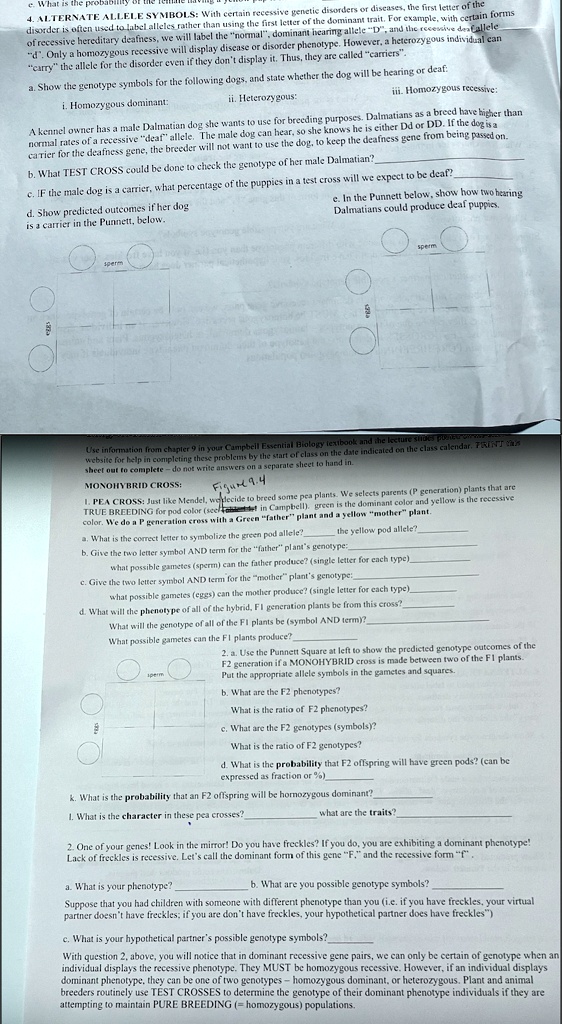
ALTERNATE ALLELE SYMBOLS: With certain recessive genetic disorders or diseases, the first letter of the disorder is often used to label alleles rather than using the first letter of the dominant trait. For example, with certain forms of recessive hereditary deafness, we will label the "normal", dominant hearing allele "D", and the recessive deaf allele "d". Only a homozygous recessive will display disease or disorder phenotype. However, a heterozygous individual can "carry" the allele for the disorder even if they don't display it. Thus, they are called "carriers".
a. Show the genotype symbols for the following dogs, and state whether the dog will be hearing or deaf:
i. Homozygous dominant:
ii. Heterozygous:
iii. Homozygous recessive:
A kennel owner has a male Dalmatian dog she wants to use for breeding purposes. Dalmatians as a breed have higher than normal rates of a recessive "deaf" allele. The male dog can hear, so she knows he is either Dd or DD. If the dog is a carrier for the deafness gene, the breeder will not want to use the dog, to keep the deafness gene from being passed on.
b. What TEST CROSS could be done to check the genotype of her male Dalmatian?
c. IF the male dog is a carrier, what percentage of the puppies in a test cross will we expect to be deaf?
d. Show predicted outcomes if her dog is a carrier in the Punnett, below.
e. In the Punnett below, show how two hearing Dalmatians could produce deaf puppies.
Use information from chapter 9 in your Campbell sheet to complete - do not write answers on a separate sheet to hand in. MONOHYBRID CROSS: Figure 9.4 color. We do a P generation cross with a Green father plant and a yellow mother plant.
a. What is the correct letter to symbolize the green pod allele? the yellow pod allele
b. Give the two-letter symbol AND term for the father plant genotype: what possible gametes sperm can the father produce single letter for each type
c. Give the two-letter symbol AND term for the mother plant's genotype: what possible gametes eggs can the mother produce? single letter for each type
d. What will the phenotype of all of the hybrid, F1 generation plants be from this cross? What will the genotype of all of the F1 plants be symbol AND term)? What possible gametes can the F1 plants produce?
2.a. Use the Punnett Square at left to show the predicted genotype outcomes of the F2 generation if a MONOHYBRID cross is made between two of the F1 plants. Put the appropriate allele symbols in the gametes and squares.
b. What are the F2 phenotypes? What is the ratio of F2 phenotypes?
c. What are the F2 genotypes (symbols)? What is the ratio of F2 genotypes?
d. What is the probability that F2 offspring will have green pods? (can be expressed as fraction or %)
e. What is the probability that an F2 offspring will be homozygous dominant?
1. What is the character in these pea crosses? what are the traits?
2. One of your genes! Look in the mirror Do you have freckles? If you do, you are exhibiting a dominant phenotype! Lack of freckles is recessive. Let's call the dominant form of this gene F, and the recessive form f
a. What is your phenotype? b. What are your possible genotype symbols Suppose that you had children with someone with a different phenotype than you (i.e. if you have freckles, your virtual partner doesn't have freckles; if you don't have freckles, your hypothetical partner does have freckles)
c. What is your hypothetical partner's possible genotype symbols? With question 2, above, you will notice that in dominant-recessive gene pairs, we can only be certain of genotype when an individual displays the recessive phenotype. They MUST be homozygous recessive. However, if an individual displays the dominant phenotype, they can be one of two genotypes - homozygous dominant, or heterozygous. Plant and animal breeders routinely use TEST CROSSES to determine the genotype of their dominant phenotype individuals if they are attempting to maintain PURE BREEDING (=homozygous) populations.