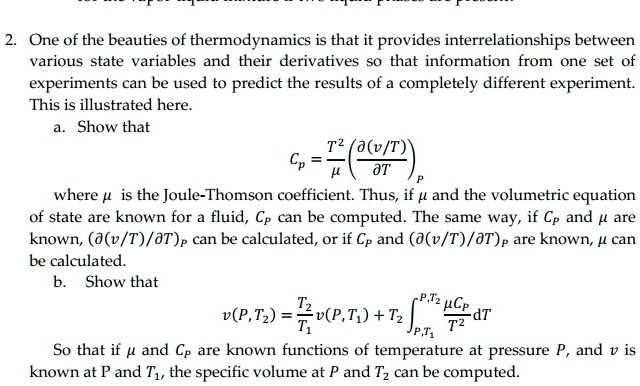
2. One of the beauties of thermodynamics is that it provides interrelationships between
various state variables and their derivatives so that information from one set of
experiments can be used to predict the results of a completely different experiment.
This is illustrated here.
a. Show that
$C_p = \frac{T^2}{\mu} \left(\frac{\partial (v/T)}{\partial T}\right)_p$
where $\mu$ is the Joule-Thomson coefficient. Thus, if $\mu$ and the volumetric equation
of state are known for a fluid, $C_p$ can be computed. The same way, if $C_p$ and $\mu$ are
known, $(\partial (v/T)/\partial T)_p$ can be calculated, or if $C_p$ and $(\partial (v/T)/\partial T)_p$ are known, $\mu$ can
be calculated.
b. Show that
$v(P, T_2) = \frac{T_2}{T_1} v(P, T_1) + T_2 \int_{P, T_1}^{P, T_2} \frac{\mu C_p}{T^2} dT$
So that if $\mu$ and $C_p$ are known functions of temperature at pressure P, and $v$ is
known at P and $T_1$, the specific volume at P and $T_2$ can be computed.