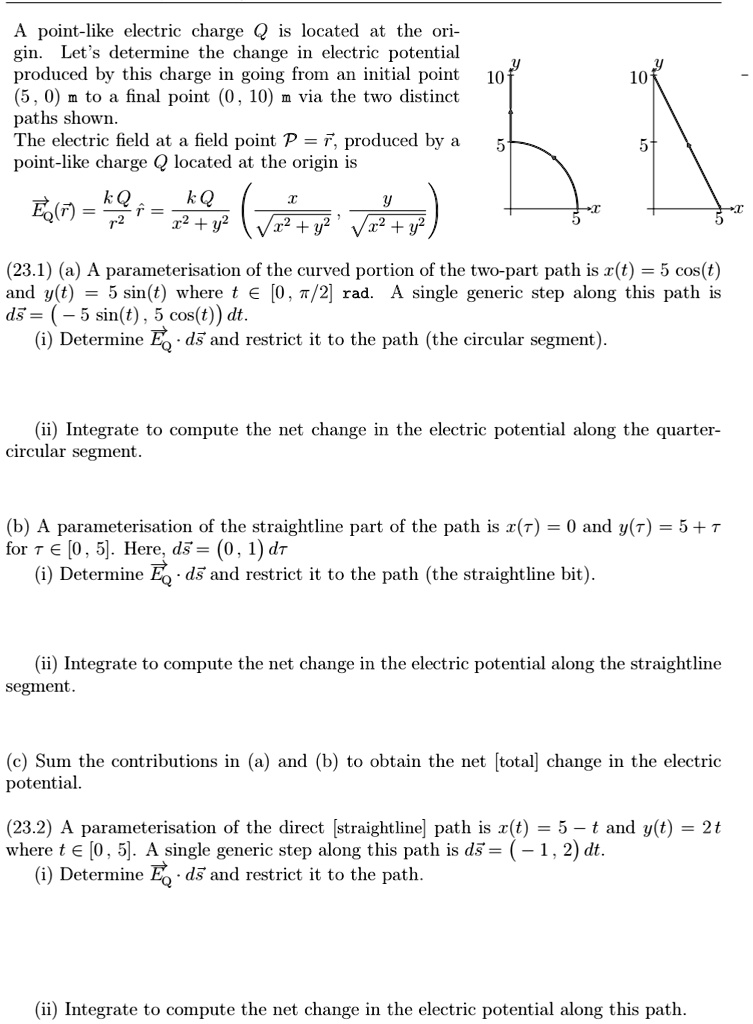
A point-like electric charge Q is located at the origin. Let's determine the change in electric potential produced by this charge in going from an initial point (5, 0) m to a final point (0, 10) m via the two distinct paths shown.
The electric field at a field point P = 7, produced by a point-like charge Q located at the origin is
$$E(\vec{r}) = \frac{kQ}{r^2}\hat{r} = \frac{kQ}{x^2 + y^2} \left( \frac{x}{\sqrt{x^2 + y^2}}, \frac{y}{\sqrt{x^2 + y^2}} \right)$$
(23.1) (a) A parameterisation of the curved portion of the two-part path is x(t) = 5 cos(t) and y(t)= 5 sin(t) where t ∈ [0, π/2] rad. A single generic step along this path is ds = (5 sin(t), 5 cos(t)) dt.
(i) Determine E<sub>Q</sub> · ds and restrict it to the path (the circular segment).
(ii) Integrate to compute the net change in the electric potential along the quarter-circular segment.
(b) A parameterisation of the straightline part of the path is x(τ) = 0 and y(τ) = 5 + τ for τ ∈ [0, 5]. Here, ds = (0, 1) dτ
(i) Determine E<sub>Q</sub> · ds and restrict it to the path (the straightline bit).
(ii) Integrate to compute the net change in the electric potential along the straightline segment.
(c) Sum the contributions in (a) and (b) to obtain the net [total] change in the electric potential.
(23.2) A parameterisation of the direct [straightline] path is x(t) = 5t and y(t) = 2t where t∈ [0, 5]. A single generic step along this path is ds = (1, 2) dt.
(i) Determine E<sub>Q</sub> · ds and restrict it to the path.
(ii) Integrate to compute the net change in the electric potential along this path.