Ace - AI Tutor
Ask Our Educators
Textbooks
My Library
Flashcards
Scribe - AI Notes
Notes & Exams
Download App
Tony Blackwell

Tony B.

Divider

Questions asked

INSTANT ANSWER

Using the (ε-δ)-definition of continuity, show that the real-valued function f (x) = 2x^2 +1 is continuous at x = 2.

View Answer
divider
ANSWERED

Kritika Mishra verified

Numerade educator

A particle, of mass 2 kg, is attached to one end of a light elastic string of natural length 0.2 metres. The other end of the string is attached to a fixed point O. The particle is pulled down and released from rest at a point 0.6 metres directly below O. The particle then moves vertically and next comes to rest when it is 0.1 metres below O. Assume that no air resistance acts on the particle. Find the maximum speed of the particle.

View Answer
divider
INSTANT ANSWER

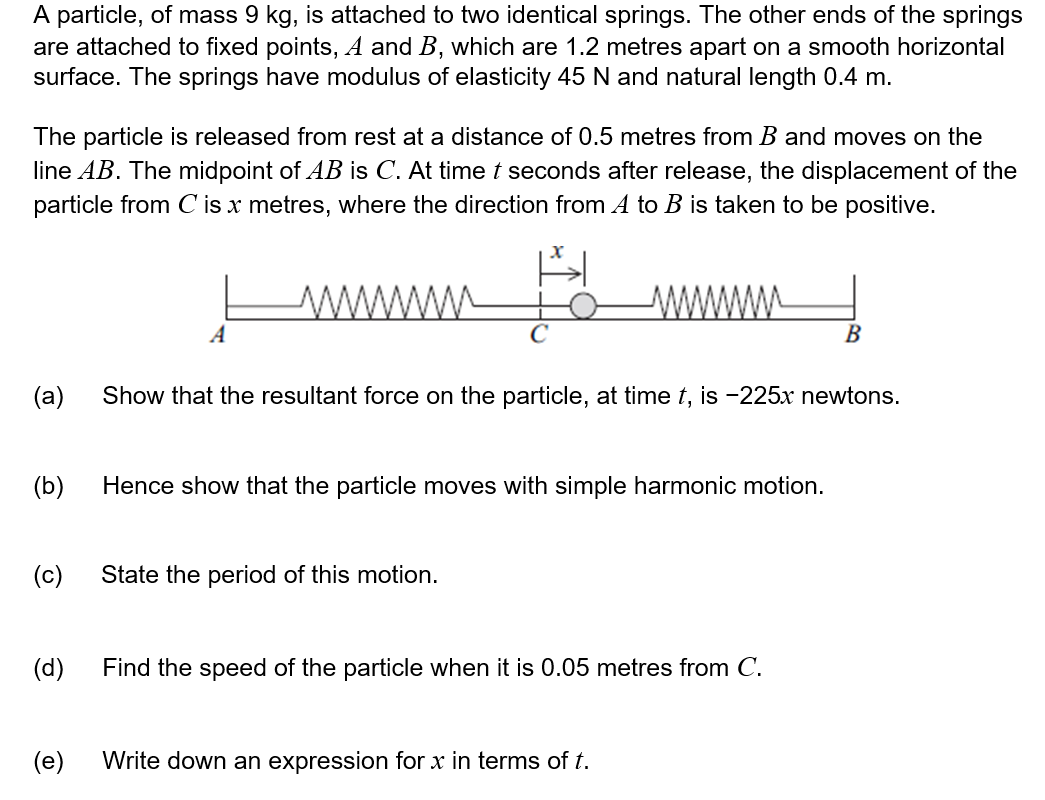
A particle, of mass \( 9 \mathrm{~kg} \), is attached to two identical springs. The other ends of the springs are attached to fixed points, \( A \) and \( B \), which are \( 1.2 \) metres apart on a smooth horizontal surface. The springs have modulus of elasticity \( 45 \mathrm{~N} \) and natural length \( 0.4 \mathrm{~m} \). The particle is released from rest at a distance of \( 0.5 \) metres from \( B \) and moves on the line \( A B \). The midpoint of \( A B \) is \( C \). At time \( t \) seconds after release, the displacement of the particle from \( C \) is \( x \) metres, where the direction from \( A \) to \( B \) is taken to be positive. (a) Show that the resultant force on the particle, at time \( t \), is \( -225 x \) newtons. (b) Hence show that the particle moves with simple harmonic motion. (c) State the period of this motion. (d) Find the speed of the particle when it is \( 0.05 \) metres from \( C \). (e) Write down an expression for \( x \) in terms of \( t \).
View Answer
divider
ANSWERED

Lane Francis verified

Numerade educator

A particle moves around the sides of a regular hexagon ABCDEF of side 3m. The particle starts from A and moves in the sense ABC. What is the displacement from A when it is at the midpoint of DE.

View Answer
divider