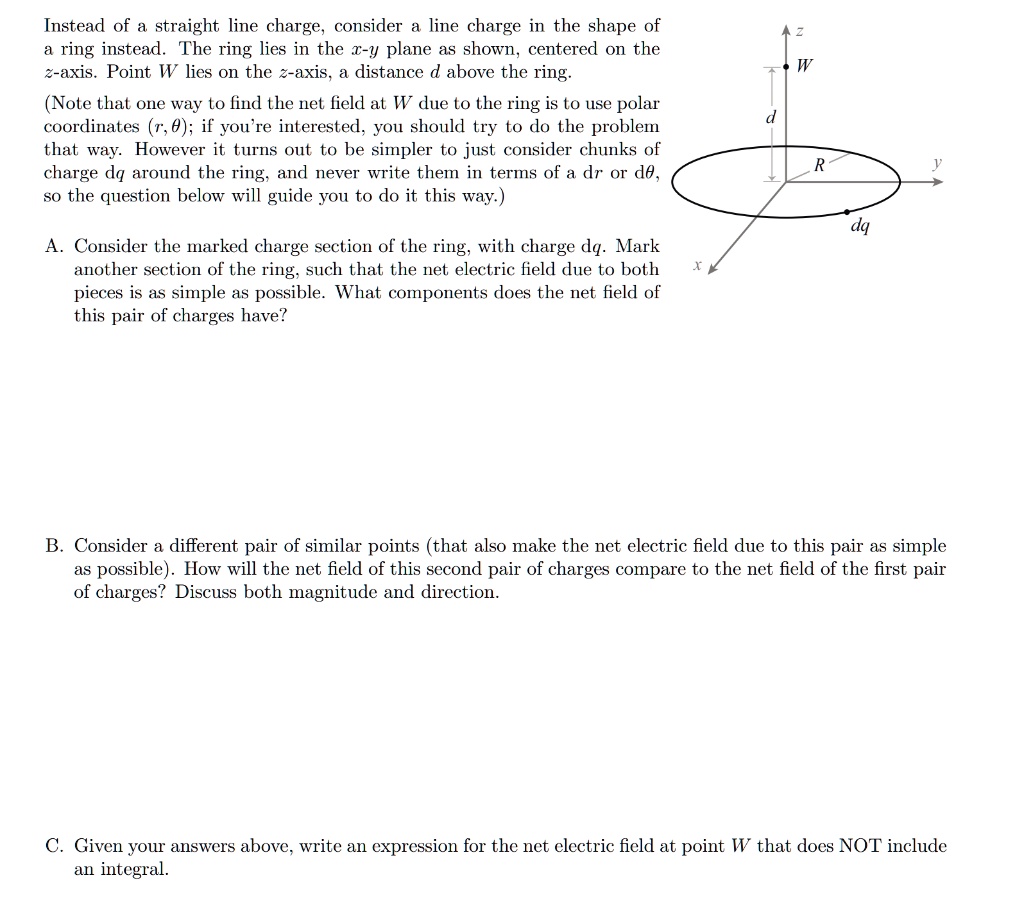
Instead of a straight line charge, consider a line charge in the shape of
a ring instead. The ring lies in the x-y plane as shown, centered on the
z-axis. Point W lies on the z-axis, a distance d above the ring.
(Note that one way to find the net field at W due to the ring is to use polar
coordinates (r, $\theta$); if you're interested, you should try to do the problem
that way. However it turns out to be simpler to just consider chunks of
charge dq around the ring, and never write them in terms of a dr or d$\theta$,
so the question below will guide you to do it this way.)
A. Consider the marked charge section of the ring, with charge dq. Mark
another section of the ring, such that the net electric field due to both
pieces is as simple as possible. What components does the net field of
this pair of charges have?
B. Consider a different pair of similar points (that also make the net electric field due to this pair as simple
as possible). How will the net field of this second pair of charges compare to the net field of the first pair
of charges? Discuss both magnitude and direction.
C. Given your answers above, write an expression for the net electric field at point W that does NOT include
an integral.