Ace - AI Tutor
Ask Our Educators
Textbooks
My Library
Flashcards
Scribe - AI Notes
Notes & Exams
Download App
tony smith

tony s.

Divider

Questions asked

BEST MATCH

Question 15 1 pts Which client should the nurse assess most closely for swallowing difficulties prior to administering an oral medication? An older adult client who has an active lower gastrointestinal bleed A client who expressed a preference for alternative and complementary therapies An older adult diagnosed with Parkinson disease A client who is emotionally distraught after receiving a negative prognosis Next

View Answer
divider
BEST MATCH

These health professionals assist, facilitate, and complement work of physicians and other health care specialists. SELECT ALL THAT APPLY. A Surgeons B Social Workers C Clinical Laboratory Scientists D Physical Therapists

View Answer
divider
BEST MATCH

A system can be taken from state \( a \) to state \( b \) along any of the three paths shown in the \( p-V \) diagram. If state \( b \) has greater internal energy than state \( a \), along which path is there a net flow of heat out of the system? A. path 1 B. path 2 C. path 3 D. all of paths 1,2 , and 3 E. none of paths 1,2 , or 3

View Answer
divider
BEST MATCH

HOMEOSTASIS is the state where an organism has a desire or need to \( \qquad \) be in balance get in balance with others move out of balance

View Answer
divider
BEST MATCH

What purpose is served by the numerous folds and millions of microscopic projections in the jejunum? They increase peristalsis to allow for better movement through the intestine. They increase the surface area to allow for greater absorption. They secrete bile to facilitate digestion. They release substances to neutralize stomach acid.

View Answer
divider
BEST MATCH

Consider that the monopolist faces a market inverse demand function: P(Q)=100 - Q, and the total cost function is given by: C(Q = Q?. Given this information, answer the following. a) Compute the revenue function of the monopolist b) What would be the monopoly price for the product? c) What level of quantity, Q, will maximize the monopoly profit? d) Compute the monopoly profit.

View Answer
divider
BEST MATCH

If one mole of atoms or molecules is equal to 6.022*10^(23) atoms or molecules, how many molecules are in a 23.45g sample of copper (II) hydroxide, Cu(OH)â‚‚? (MM of Cu(OH)â‚‚ is 97.562 (g)/(mol))

View Answer
divider
BEST MATCH

$\sum F_x = 0$; $4000N \cos 30^\circ - C_x - A_x = 0$ $\sum F_y = 0$; $4000N \sin 30^\circ - A_y - C_y = 0$ $\sum M_C$; $-A_y \times 0.5m + 4000 \sin 30^\circ \times 0.25m = 0$ $= -500$ $A_y = -1000$

View Answer
divider
BEST MATCH

(a) Write pseudo-code for the DFS algorithm, including both the main calling program and DFS beginning with a particular source vertex. (b) Explain how DFS can be used to solve three of the following four problems: cycle-detection, Eulerian circuit, topological sort, and transitive closure.

View Answer
divider
BEST MATCH

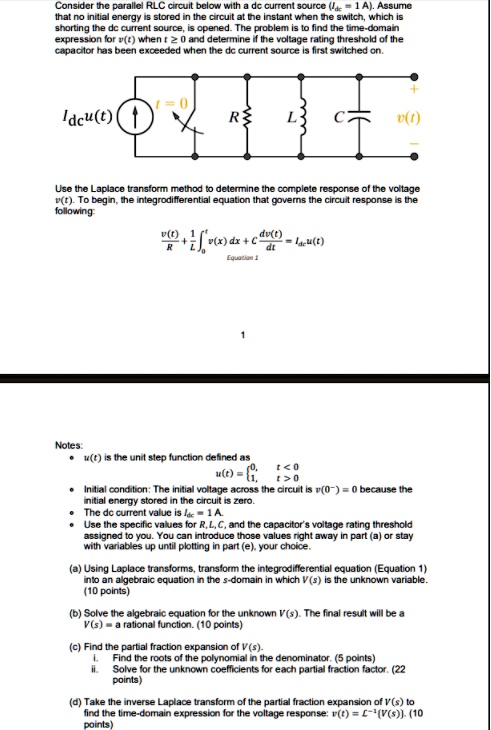
R = 75 Ohms L = 70 mH C = 15 millifarads t_end = 0.1 second Voltage rating = 1.5 kV 1A. Assume that no initial energy is stored in the circuit when the switch, which is shorting the DC current source, is opened. The problem is to find the time-domain expression for v(t) when t > 0 and determine if the voltage rating threshold of the capacitor has been exceeded when the DC current source is first switched on. v(t) = I * u(t) (Equation 1) Notes: - u(t) is the unit step function defined as u(t) = 0, t < 0 and u(t) = 1, t > 0. - Initial condition: The initial voltage across the circuit is v(0) = 0 because the initial energy stored in the circuit is zero. - The DC current value is I = 1 A. - Use the specific values for R, L, C, and the capacitor's voltage rating threshold assigned to you. You can introduce those values right away in part (a) or later. (a) Using Laplace transforms, transform the integrodifferential equation (Equation 1) into an algebraic equation in the s-domain, where V(s) is the unknown variable. (10 points) (b) Solve the algebraic equation for the unknown V(s). The final result will be a rational function. (10 points) (c) Find the partial fraction expansion of V(s). Find the roots of the polynomial in the denominator. (5 points) II. Solve for the unknown coefficients for each partial fraction factor. (22 points) (d) Take the inverse Laplace transform of the partial fraction expansion of V(s) to find the time-domain expression for the voltage response: v(t) = 1/V(s). (10 points)
View Answer
divider