10. 60 points Program B Let G = (V, E) be an undirected graph. A Hamiltonian path
is a path that visits every vertex v ? V exactly once. You will write a program that will
read in a representation of a graph from a plain text file with the following format: the
first line is n, the number of vertices in G which are numbered 0 through n-1. Each line
after that contains a sequence of space-delimited numbers. The first number is a vertex
v and each following number is a vertex that v is connected to. This is an undirected
graph so the symmetric edges may or may not be present in the representation. An
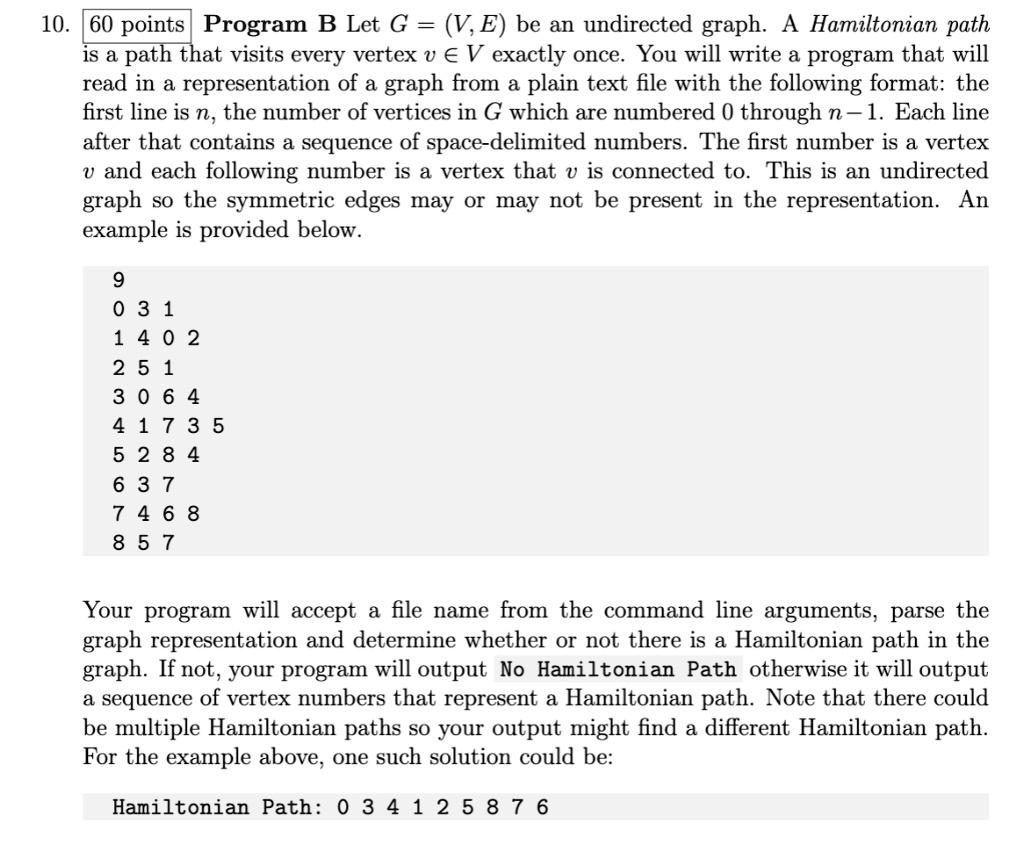
example is provided below.
9
0 3 1
1 4 0 2
2 5 1
3 0 6 4
4 1 7 3 5
5 2 8 4
6 3 7
7 4 6 8
8 5 7
Your program will accept a file name from the command line arguments, parse the
graph representation and determine whether or not there is a Hamiltonian path in the
graph. If not, your program will output No Hamiltonian Path otherwise it will output
a sequence of vertex numbers that represent a Hamiltonian path. Note that there could
be multiple Hamiltonian paths so your output might find a different Hamiltonian path.
For the example above, one such solution could be:
Hamiltonian Path: 0 3 4 1 2 5 8 7 6