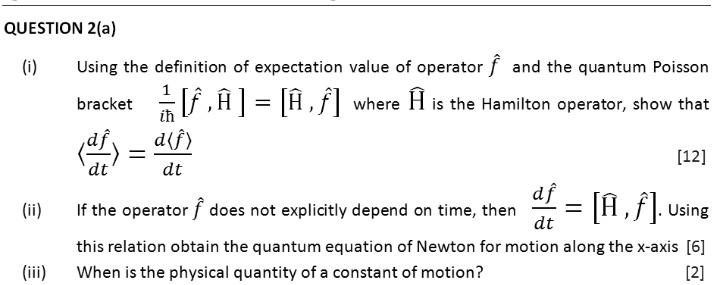
QUESTION 2(a)
(i) Using the definition of expectation value of operator \(\hat{f}\) and the quantum Poisson
bracket \(\frac{1}{i\hbar}[\hat{f}, \hat{H}] = [\hat{H}, \hat{f}]\) where \(\hat{H}\) is the Hamilton operator, show that
\(\left<\frac{d\hat{f}}{dt}\right> = \frac{d<\hat{f}>}{dt}\)
[12]
(ii) If the operator \(\hat{f}\) does not explicitly depend on time, then \(\frac{d\hat{f}}{dt} = [\hat{H}, \hat{f}]\). Using
this relation obtain the quantum equation of Newton for motion along the x-axis [6]
(iii) When is the physical quantity of a constant of motion?
[2]