Payback Period
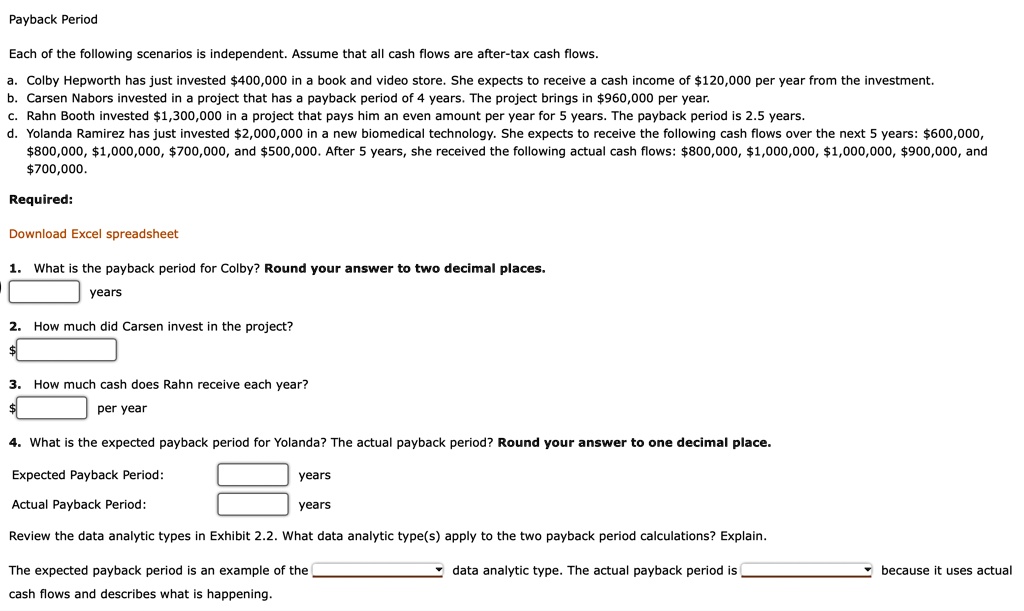
Each of the following scenarios is independent. Assume that all cash flows are after-tax cash flows.
a. Colby Hepworth has just invested $400,000 in a book and video store. She expects to receive a cash income of $120,000 per year from the investment.
b. Carsen Nabors invested in a project that has a payback period of 4 years. The project brings in $960,000 per year.
c. Rahn Booth invested $1,300,000 in a project that pays him an even amount per year for 5 years. The payback period is 2.5 years.
d. Yolanda Ramirez has just invested $2,000,000 in a new biomedical technology. She expects to receive the following cash flows over the next 5 years: $600,000,
$800,000, $1,000,000, $700,000, and $500,000. After 5 years, she received the following actual cash flows: $800,000, $1,000,000, $1,000,000, $900,000, and
$700,000.
Required:
Download Excel spreadsheet
1. What is the payback period for Colby? Round your answer to two decimal places.
years
2. How much did Carsen invest in the project?
3. How much cash does Rahn receive each year?
per year
4. What is the expected payback period for Yolanda? The actual payback period? Round your answer to one decimal place.
Expected Payback Period:
years
Actual Payback Period:
years
Review the data analytic types in Exhibit 2.2. What data analytic type(s) apply to the two payback period calculations? Explain.
The expected payback period is an example of the
cash flows and describes what is happening.
data analytic type. The actual payback period is
because it uses actual