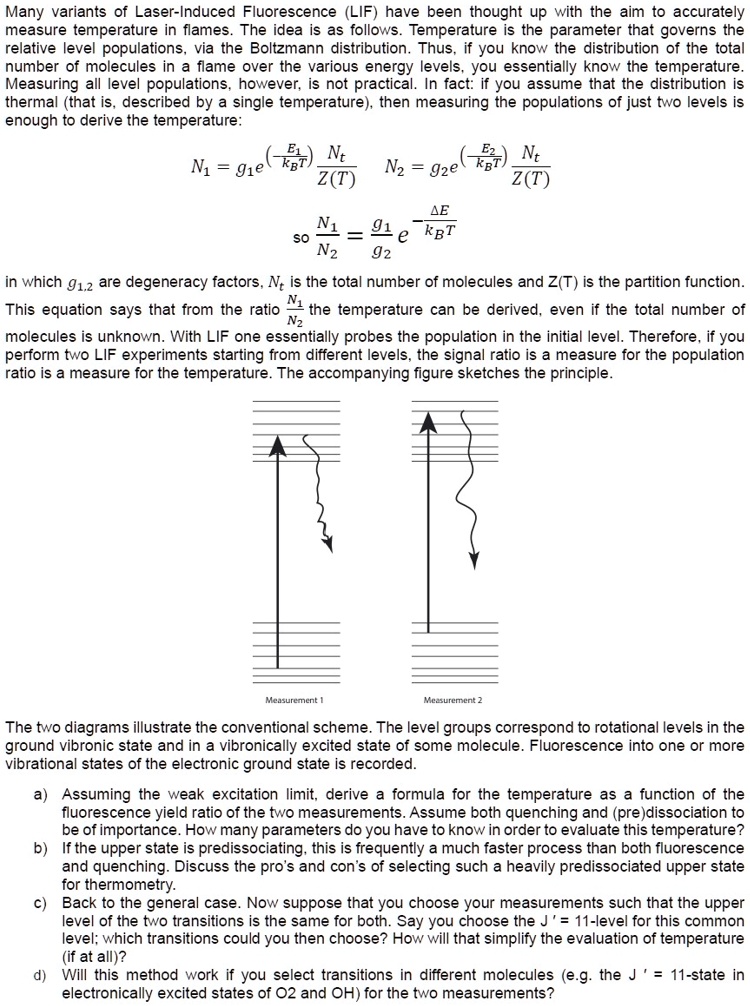
Many variants of Laser-Induced Fluorescence (LIF) have been thought up with the aim to accurately measure temperature in flames. The idea is as follows. Temperature is the parameter that governs the relative level populations, via the Boltzmann distribution. Thus, if you know the distribution of the total number of molecules in a flame over the various energy levels, you essentially know the temperature. Measuring all level populations, however, is not practical. In fact: if you assume that the distribution is thermal (that is, described by a single temperature), then measuring the populations of just two levels is enough to derive the temperature:
$$N_1 = g_1e^{- \frac{E_1}{k_BT}} \frac{N_t}{Z(T)}$$
$$N_2 = g_2e^{- \frac{E_2}{k_BT}} \frac{N_t}{Z(T)}$$
so
$$\frac{N_1}{N_2} = \frac{g_1}{g_2}e^{- \frac{\Delta E}{k_BT}}$$
in which $g_{1,2}$ are degeneracy factors, $N_t$ is the total number of molecules and $Z(T)$ is the partition function. This equation says that from the ratio $\frac{N_1}{N_2}$ the temperature can be derived, even if the total number of molecules is unknown. With LIF one essentially probes the population in the initial level. Therefore, if you perform two LIF experiments starting from different levels, the signal ratio is a measure for the population ratio is a measure for the temperature. The accompanying figure sketches the principle.
Measurement 1
Measurement 2
The two diagrams illustrate the conventional scheme. The level groups correspond to rotational levels in the ground vibronic state and in a vibronically excited state of some molecule. Fluorescence into one or more vibrational states of the electronic ground state is recorded.
a) Assuming the weak excitation limit, derive a formula for the temperature as a function of the fluorescence yield ratio of the two measurements. Assume both quenching and (pre)dissociation to be of importance. How many parameters do you have to know in order to evaluate this temperature?
b) If the upper state is predissociating, this is frequently a much faster process than both fluorescence and quenching. Discuss the pro's and con's of selecting such a heavily predissociated upper state for thermometry.
c) Back to the general case. Now suppose that you choose your measurements such that the upper level of the two transitions is the same for both. Say you choose the J' = 11-level for this common level; which transitions could you then choose? How will that simplify the evaluation of temperature (if at all)?
d) Will this method work if you select transitions in different molecules (e.g. the J' = 11-state in electronically excited states of O2 and OH) for the two measurements?