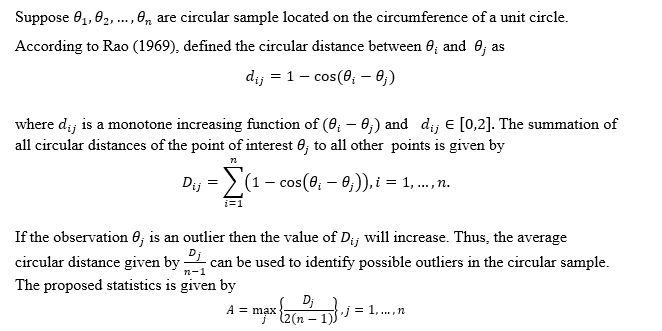
Suppose $\theta_1, \theta_2, ..., \theta_n$ are circular sample located on the circumference of a unit circle.
According to Rao (1969), defined the circular distance between $\theta_i$ and $\theta_j$ as
$d_{ij} = 1 - \cos(\theta_i - \theta_j)$
where $d_{ij}$ is a monotone increasing function of ($\theta_i - \theta_j$) and $d_{ij} \in [0, 2]$. The summation of
all circular distances of the point of interest $\theta_j$ to all other points is given by
$D_{ij} = \sum_{i=1}^{n} (1 - \cos(\theta_i - \theta_j)), i = 1, ..., n.$
If the observation $\theta_j$ is an outlier then the value of $D_{ij}$ will increase. Thus, the average
circular distance given by $\frac{D_j}{n-1}$ can be used to identify possible outliers in the circular sample.
The proposed statistics is given by
$A = \max_j \{\frac{D_j}{2(n-1)}\}, j = 1, ..., n$