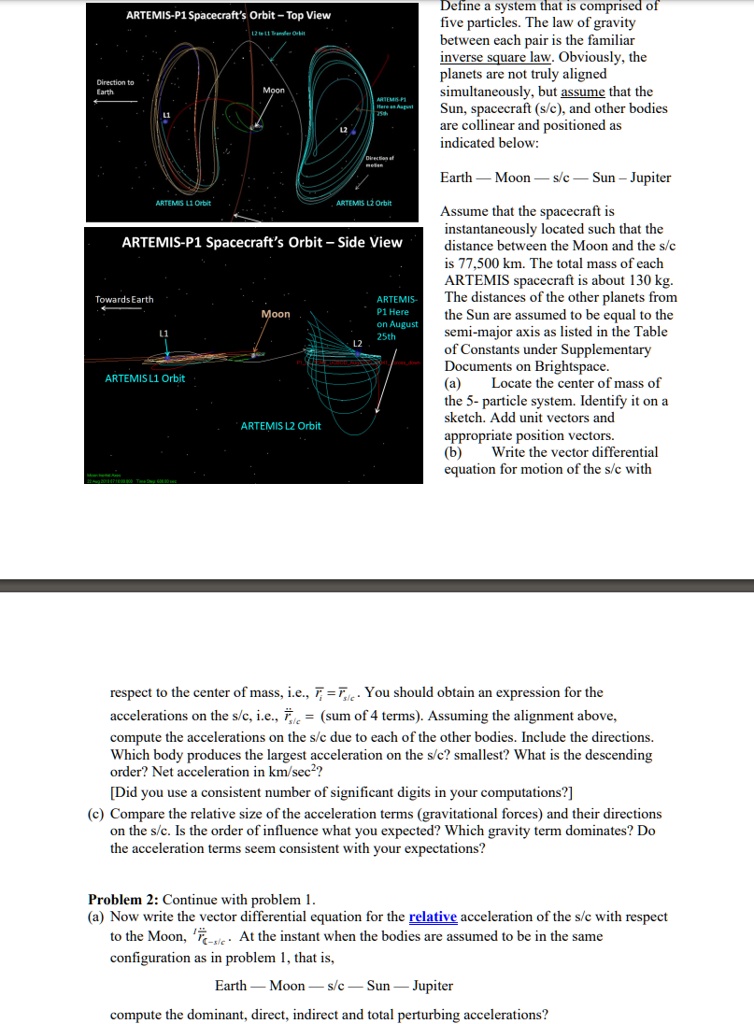
ARTEMIS-P1 Spacecraft's Orbit - Top View
Direction to
Earth
ARTEMIS L1 Orbit
Moon
ARTEMIS L2 Orbit
ARTEMIS-P1 Spacecraft's Orbit - Side View
Towards Earth
Moon
ARTEMIS L1 Orbit
ARTEMIS L2 Orbit
L2
ARTEMIS-
P1 Here
on August
25th
Define a system that is comprised of
five particles. The law of gravity
between each pair is the familiar
inverse square law. Obviously, the
planets are not truly aligned
simultaneously, but assume that the
Sun, spacecraft (s/c), and other bodies
are collinear and positioned as
indicated below:
Earth Moon
s/c
Sun - Jupiter
Assume that the spacecraft is
instantaneously located such that the
distance between the Moon and the s/c
is 77,500 km. The total mass of each
ARTEMIS spacecraft is about 130 kg.
The distances of the other planets from
the Sun are assumed to be equal to the
semi-major axis as listed in the Table
of Constants under Supplementary
Documents on Brightspace.
(a) Locate the center of mass of
the 5- particle system. Identify it on a
sketch. Add unit vectors and
appropriate position vectors.
(b)
Write the vector differential
equation for motion of the s/c with
respect to the center of mass, i.e., F. You should obtain an expression for the
accelerations on the s/c, i.e., (sum of 4 terms). Assuming the alignment above,
compute the accelerations on the s/c due to each of the other bodies. Include the directions.
Which body produces the largest acceleration on the s/c? smallest? What is the descending
order? Net acceleration in km/sec²?
[Did you use a consistent number of significant digits in your computations?]
(c) Compare the relative size of the acceleration terms (gravitational forces) and their directions
on the s/c. Is the order of influence what you expected? Which gravity term dominates? Do
the acceleration terms seem consistent with your expectations?
Problem 2: Continue with problem 1.
(a) Now write the vector differential equation for the relative acceleration of the s/c with respect
to the Moon,
At the instant when the bodies are assumed to be in the same
configuration as in problem 1, that is,
Earth Moon
s/c
Sun Jupiter
compute the dominant, direct, indirect and total perturbing accelerations?