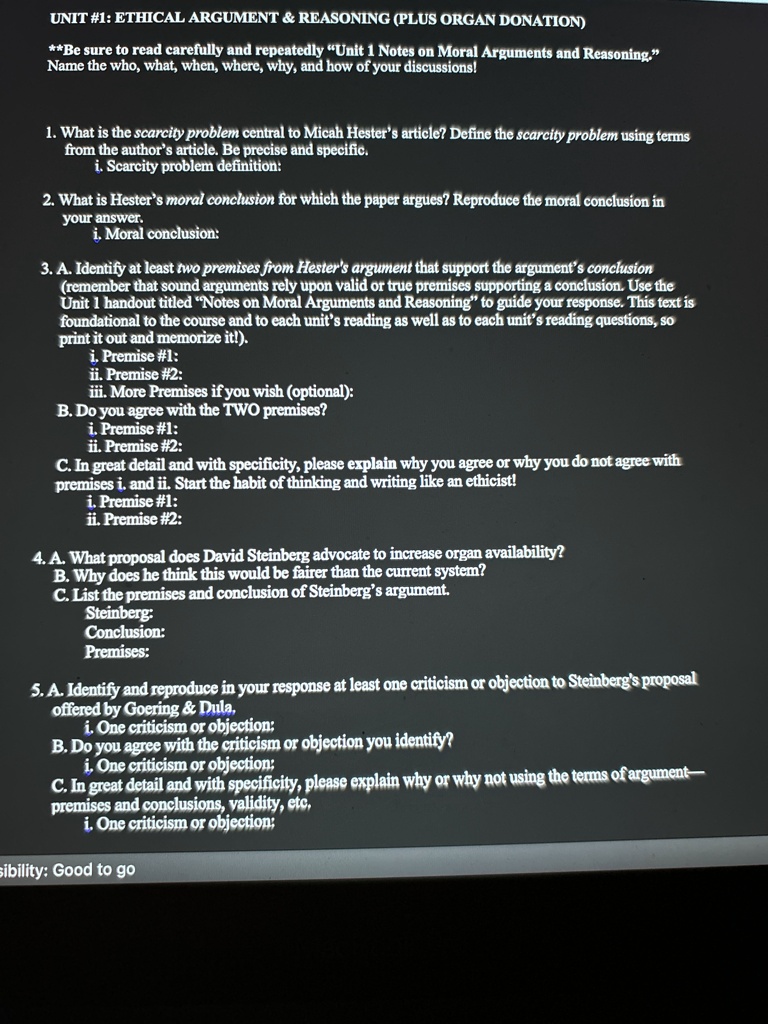
UNIT #1: ETHICAL ARGUMIENT & RDASONING (PLUS ORGAN DONATION)
**Be sure to read carefully and repeatedly "Unit 1 Notes on Moral Arguments and Reasoning."
Name the who, what, when, where, why, and how of your discussions!
What is the scarcity problem central to Micah Hester's article? Define the scarcity problem using terms
from the author's article. Be precise and specific.
i. Scarcity problem definition:
What is Hester's moral conclusion for which the paper argues? Reproduce the moral conclusion in
your answer.
i. Moral conclusion:
A. Identify at least two premises from Hester's argument that support the argument's conclusion
(remember that sound arguments rely upon valid or true premises supporting a conclusion. Use the
Unit 1 handout titled "Notes on Moral Arguments and Reasoning" to guide your response. This text is
foundational to the course and to each unit's reading as well as to each unit's reading questions, so
print it out and memorize itl).
i. Premise #1:
ii. Premise #2:
iii. More Premises if you wish (optional):
B. Do you agree with the TWO premises?
i. Premise #1:
ii. Premise #2:
C. In great detail and with specificity, please explain why you agree or why you do not agree with
premises i. and ii. Start the habit of thinking and writing like an ethicist!
i. Premise #1:
ii. Premise #2:
A. What proposal does David Steinberg advocate to increase organ availability?
B. Why does he think this would be fairer than the current system?
C. List the premises and conclusion of Steinberg's argument.
Steinberg:
Conclusion:
Premises:
A. Identify and reproduce in your response at least one criticism or objection to Steinberg's proposal
offered by Goering & Dula,
i. One criticism or objection:
B. Do you agree with the criticism or objection you identify?
One criticism or objection:
C. In great detail and with specificity, please explain why or why not using the terms of argument-
premises and conclusions, validity, etch
i. One criticism or objections
UNIT #1: ETHICAL ARGUMENT & REASONING (PLUS ORGAN DONATION)
Name the who, what, when, where, why, and how of your discussions!
1. What is the scarcity problem central to Micah Hester's article? Define the scarcity problem using terms from the author's article. Be precise and specific i. Scarcity problem definition
2.What is Hester's moral conclusion for which the paper argues? Reproduce the moral conclusion in your answer. i, Moral conclusion
3.A.Identify at least two premises from Hester's argument that support the argument's conclusion (remember that sound arguments rely upon valid or true premises supporting a conclusion. Use the Unit l handout titled Notes on Moral Arguments and Reasoning"to guide your response.This text is foundational to the course and to each unit's reading as well as to each unit's reading questions,so print it out and memorize it!). i.Premise#1 ii.Premise#2: iii.More Premises if you wish (optional) B.Do you agree with the TWO premises? i.Premise#1: ii.Premise#2 C. In great detail and with specificity,please explain why you agree or why you do not agree with
i.Premise#1 ii.Premise #2:
4.A.What proposal does David Steinberg advocate to increase organ availability B.Why does he think this would be fairer than the current system? C. List the premises and conclusion of Steinberg's argument. Steinberg: Conclusion: Premises: 5.A.Identify and reproduce in your response at least one criticism or objection to Steinberg's proposal offered by Goering & Dula i.One criticism or objection B. Do you agree with the criticism or objection you identify? i,One criticism or objection; C. In great detail and with specificity, please explain why or why not using the terms of argument- premises and conclusions,validity, etc, i. One criticism or objection;
ibility:Good to go