Ace - AI Tutor
Ask Our Educators
Textbooks
My Library
Flashcards
Scribe - AI Notes
Notes & Exams
Download App
tracy ashley

tracy a.

Divider

Questions asked

BEST MATCH

Which of the following statements regarding the new era thinking is FALSE? - Speculative bubbles and their associated new era thinking do not end definitively with a sudden, final crash. - The new era theory emerged principally as an after-the-fact interpretation of a stock market boom. -A low mortgage rate was also a factor for the housing market boom in California in 1970s. - Dow's approach to the 1,000 milestone in 1960s provided an anchor for people's expectations.

View Answer
divider
BEST MATCH

A helicopter blade spins at exactly 102 revolutions per minute. Its tip is 4.19 m from the center of rotation. What is its average velocity over one revolution? (in units of m/s

View Answer
divider
BEST MATCH

In solvolysis, a solvent molecule functions as a(n) In solvolysis, a solvent molecule functions as a(n)

View Answer
divider
BEST MATCH

Why is it important to have a strategic change or a mental health organization for adolescence

View Answer
divider
BEST MATCH

The scientist given credit for devising the two-word scientific naming system is Multiple Choice Louis Pasteur. Carolus Linnaeus. Aristotle. Gregor Mendel. Charles Darwin.

View Answer
divider
BEST MATCH

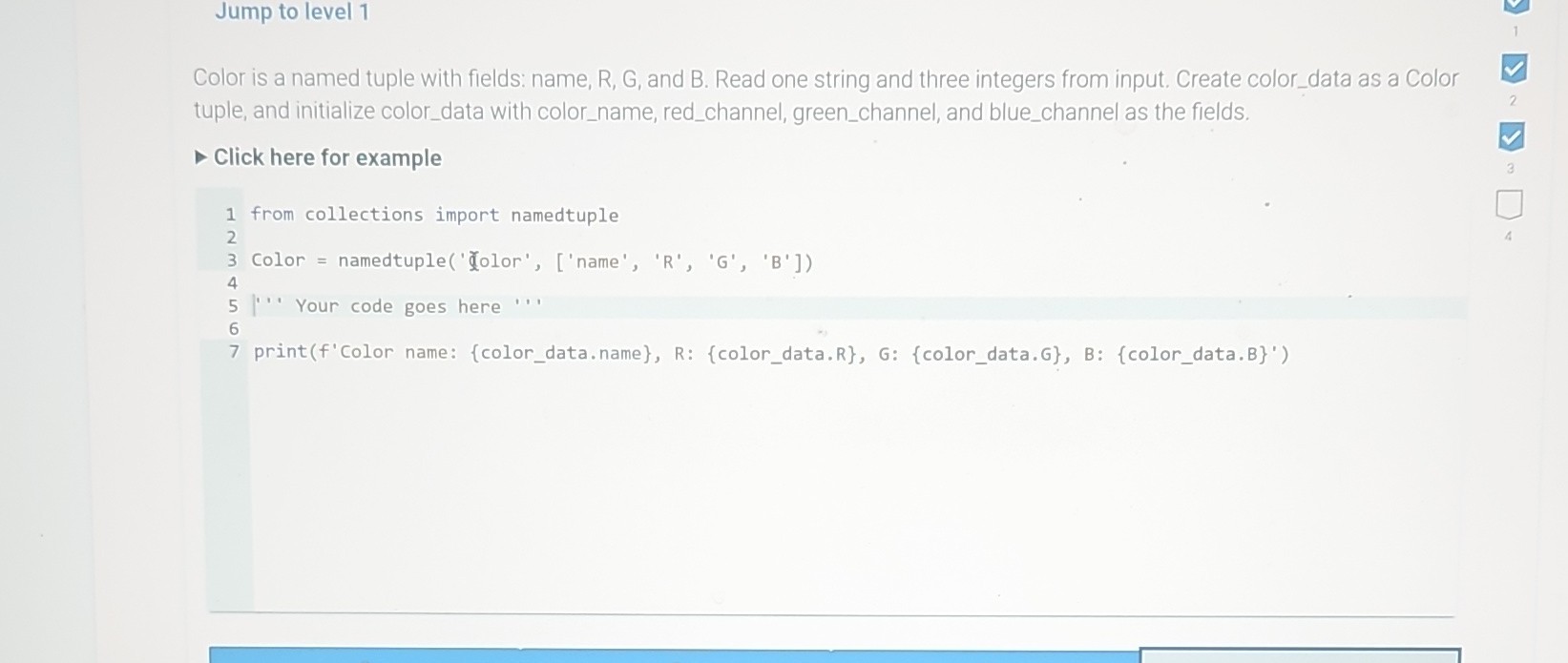
Jump to level 1 Color is a named tuple with fields: name, R, G, and B. Read one string and three integers from input. Create color_data as a Color tuple, and initialize color_data with color_name, red_channel, green_channel, and blue_channel as the fields. - Click here for example ``` from collections import namedtuple Color = namedtuple('rolor', ['name', 'R', 'G', 'B']) l'`' Your code goes here print(f'Color name: {color_data.name}, R: {color_data.R}, G: {color_data.G}, B: {color_data.B}') ```
View Answer
divider
BEST MATCH

1. Draw V and M diagrams of the beam shown in Fig. 1. 2. Determine the deformation of the steel rod shown in Fig. 2 under the given loads ($E = 29 \times 10^6 \text{ lb/in}^2$). 3. A simple beam AB of span length $L = 6.7$ m supports a uniform load of intensity $q = 22$ kN/m and a concentrated load $P = 50$ kN. The uniform load includes an allowance for the weight of the beam. The concentrated load acts at a point 2.5 m from the left-hand end of the beam. The beam is constructed of glued laminated wood and has a cross section of width $b = 220$ mm and a height $h = 700$ mm. (a) Determine the maximum tensile and compressive stresses in the beam due to bending. (b) If load $q$ is unchanged, find the maximum permissible value of load $P$ if the allowable normal stress in tension and compression is $\sigma_a = 13$ MPa.

View Answer
divider
BEST MATCH

11. The stacking sequence of close-packed planes in the face-centered cubic (FCC) crystal structure is: A. ABABAB B. ABCABC C. there are no close packed planes 12. Which of the following crystal structures does NOT contain close-packed planes? A. FCC B. BCC C. HCP 13. The packing factor for structures involving stacked close-packed planes (highest possible) is: A. 52% B. 68% C. 74% D. 100%

View Answer
divider
BEST MATCH

Q: Find the maximal value and optimal subsets in Knapsack problem below using dynamic programming. Knapsack of capacity W = 4 kg item weight value 1 1 kg $2 2 4 kg $3 3 3 kg $2 Capacity j 0 1 2 3 4 0 0 0 0 0 0 W1=1, V1 = 2 1 0 2 2 2 2 W2=4, v2=3 2 0 2 2 2 (a) w3=3, v3=2 3 0 2 2 2 (b) (1) Compute (a) and (b) in the table above (show procedures). (2 marks) (2) What is the optimal value inside the Knapsack? (1 mark) (3) Find optimal subset using backtracking method (show procedures). (2 marks)

View Answer
divider
BEST MATCH

Some experiments in this study used immunohistochemistry with primary antibodies diluted in TBST (10 mM Tris, 167 mM NaCl, and 0.05% (v/v) Tween 20). Using the information below, describe how you would make 500 ml of this solution. Show your working in your answer. [6%] Reagent information: - Molecular weights: - Tris – 121.1 - NaCl – 58.4 - Tween 20 is provided as a 100% solution. b) Once the TBST was made up as above, it was used to dilute three different antibodies, Ab1, Ab2, and Ab3. These three antibodies were used at different concentrations as shown below. Describe how you would make 500 μl of each antibody. Show your working for all calculations. [4%] Antibody dilutions: - Ab1 – 1:500 (i.e., 1 in 500 or 500-fold dilution) - Ab2 – 1:2000 - Ab3 – 1:10000 I think I've calculated the Tween 20 by 0.05%/100 x 500 = 0.25, so 25 ml. But I'm not sure if the question is asking for concentration or not.

View Answer
divider