QUESTION 7
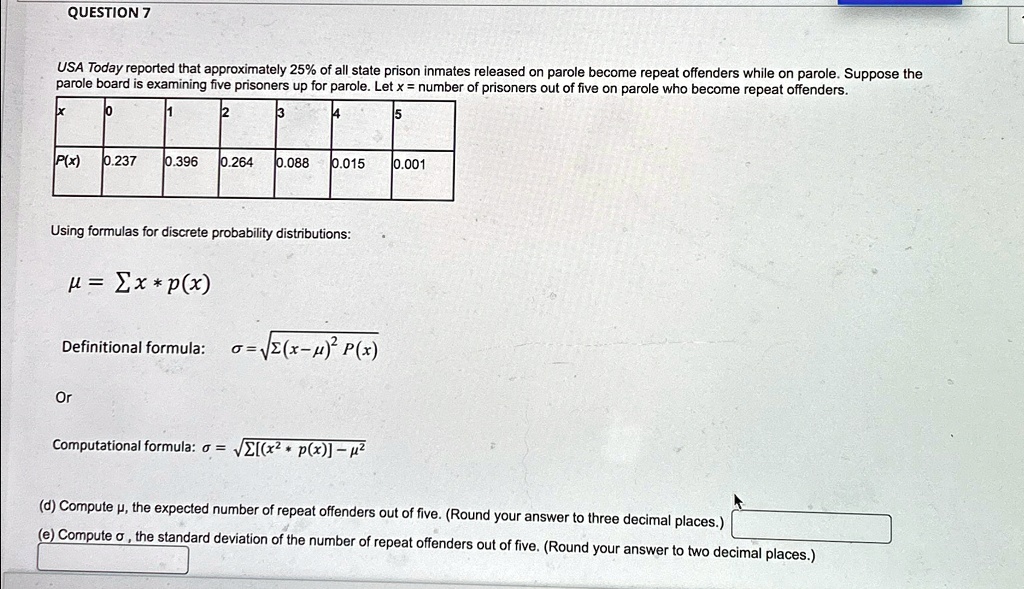
USA Today reported that approximately 25% of all state prison inmates released on parole become repeat offenders while on parole. Suppose the parole board is examining five prisoners up for parole. Let x= number of prisoners out of five on parole who become repeat offenders.
able[[x,0,1,2,3,4,5],[P(x),0.237,0.396,0.264,0.088,0.015,0.001]]
Using formulas for discrete probability distributions:
mu =sum x**p(x)
Definitional formula: ,sigma =sqrt(Sigma (x-mu )^(2)P(x))
Or
Computational formula:
(d) Compute mu , the expected number of repeat offenders out of five. (Round your answer to three decimal places.)
(e) Compute sigma . the standard deviation of the number of repeat offenders out of five. (Round your answer to two decimal places.)
QUESTION7
USA Today reported that approximately 25% of all state prison inmates released on parole become repeat offenders while on parole. Suppose the parole board is examining five prisoners up for parole. Let x = number of prisoners out of five on parole who become repeat offenders. 1 2 3 5
P(x) b.237
0.396
0.264 0.088
0.015
0.001
Using formulas for discrete probability distributions:
=Zx*p(x)
Definitional formula:=x-Px
Or
Computational formula:=[x2p(x]-2
(d) Compute , the expected number of repeat offenders out of five. (Round your answer to three decimal places.) (e) Compute a , the standard deviation of the number of repeat offenders out of five. (Round your answer to two decimal places.)