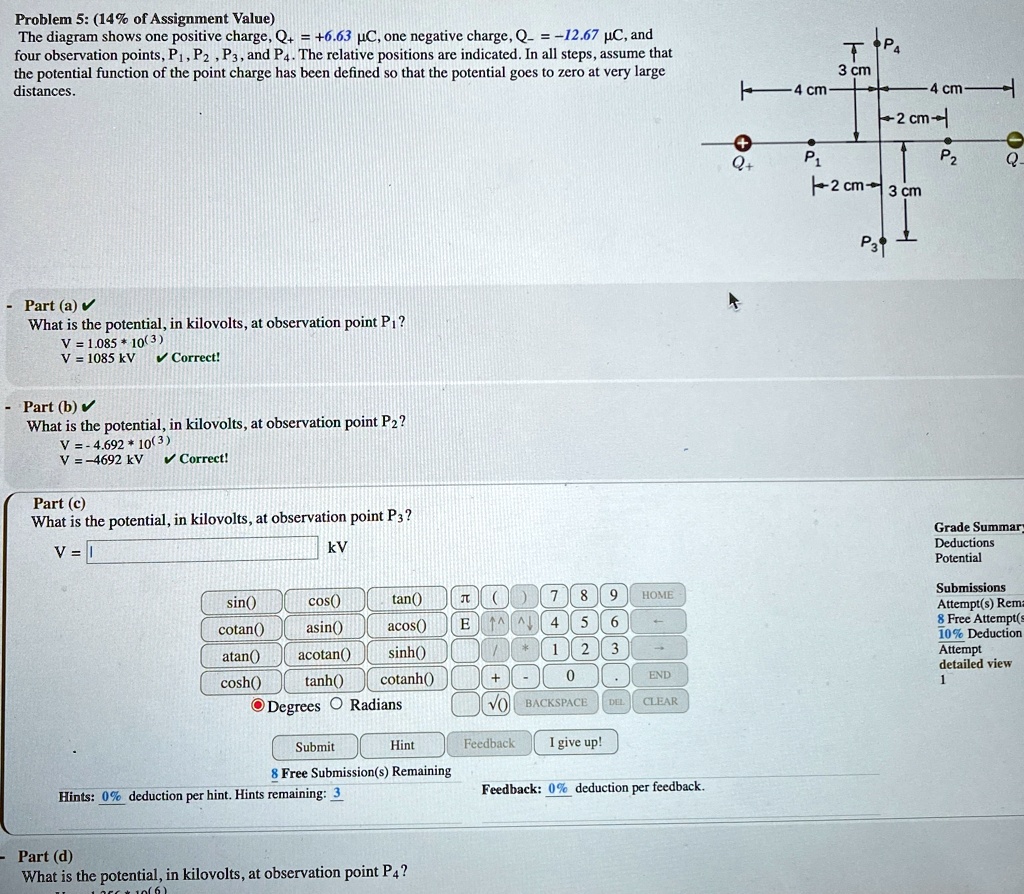
Problem 5: (14% of Assignment Value)
The diagram shows one positive charge, Q+ = +6.63 µC, one negative charge, Q- = -12.67 µC, and
four observation points, P1, P2, P3, and P4. The relative positions are indicated. In all steps, assume that
the potential function of the point charge has been defined so that the potential goes to zero at very large
distances.
Part (a)✔
What is the potential, in kilovolts, at observation point P₁?
V = 1.085 * 10(3)
V = 1085 kV ✓ Correct!
Part (b)✔
What is the potential, in kilovolts, at observation point P2?
V = -4.692 * 10(3)
V = -4692 kV ✓ Correct!
Part (c)
What is the potential, in kilovolts, at observation point P3?
V = 1
kV
Part (d)
What is the potential, in kilovolts, at observation point P4?
V = 1000 * 10(6)