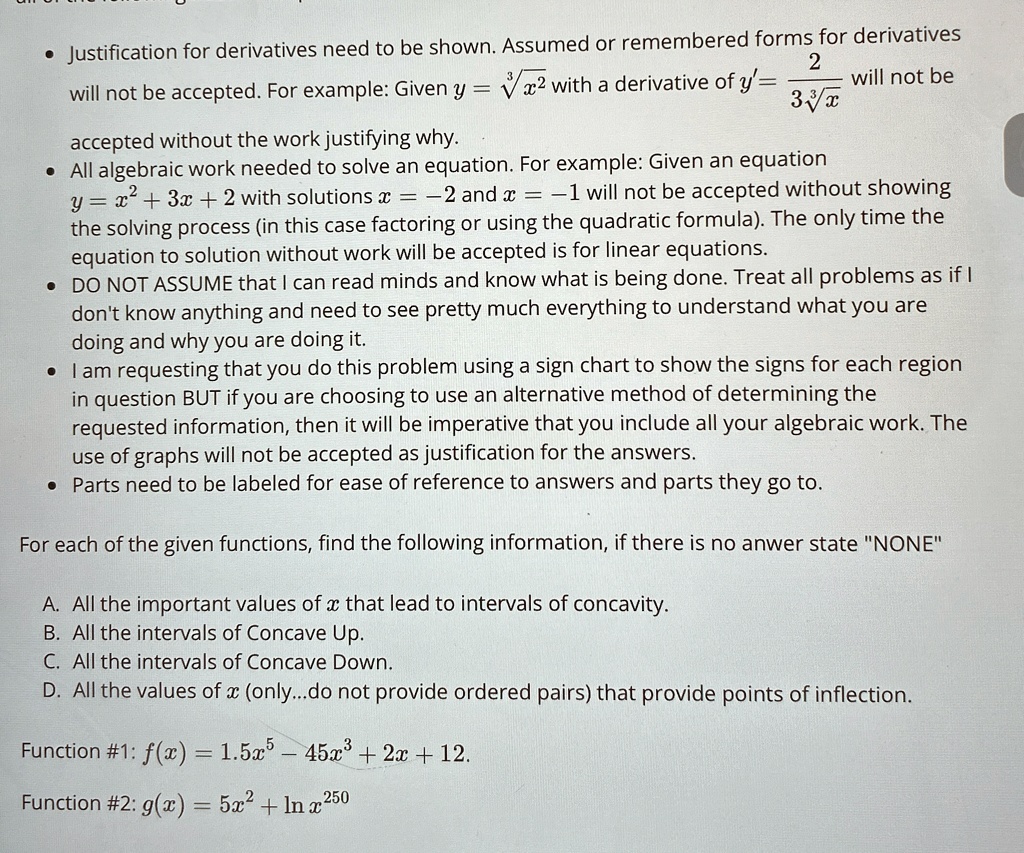
• Justification for derivatives need to be shown. Assumed or remembered forms for derivatives
will not be accepted. For example: Given $$y = \sqrt[3]{x^2}$$ with a derivative of $$y' = \frac{2}{3\sqrt[3]{x}}$$ will not be
accepted without the work justifying why.
• All algebraic work needed to solve an equation. For example: Given an equation
$$y = x^2 + 3x + 2$$ with solutions $$x = -2$$ and $$x = -1$$ will not be accepted without showing
the solving process (in this case factoring or using the quadratic formula). The only time the
equation to solution without work will be accepted is for linear equations.
• DO NOT ASSUME that I can read minds and know what is being done. Treat all problems as if I
don't know anything and need to see pretty much everything to understand what you are
doing and why you are doing it.
• I am requesting that you do this problem using a sign chart to show the signs for each region
in question BUT if you are choosing to use an alternative method of determining the
requested information, then it will be imperative that you include all your algebraic work. The
use of graphs will not be accepted as justification for the answers.
• Parts need to be labeled for ease of reference to answers and parts they go to.
For each of the given functions, find the following information, if there is no anwer state "NONE"
A. All the important values of x that lead to intervals of concavity.
B. All the intervals of Concave Up.
C. All the intervals of Concave Down.
D. All the values of x (only...do not provide ordered pairs) that provide points of inflection.
Function #1: $$f(x) = 1.5x^5 - 45x^3 + 2x + 12.$$
Function #2: $$g(x) = 5x^2 + ln x^{250}$$