Questions asked
(6 points) A child pulls horizontally on a wagon with a force of 75 N, moving it 42 m in 2.2 minutes. Over the same interval, friction does −500 J of work. The average power generated by the child is closest to
Prove that the inverse of g1g2⋯gn is inverse gn* inverse gn-1*, ..., *inverse g1 .
What does the effectiveness of internal controls influence? Group of answer choices Control risk. Detection risk. Inherent risk. Auditor risk.
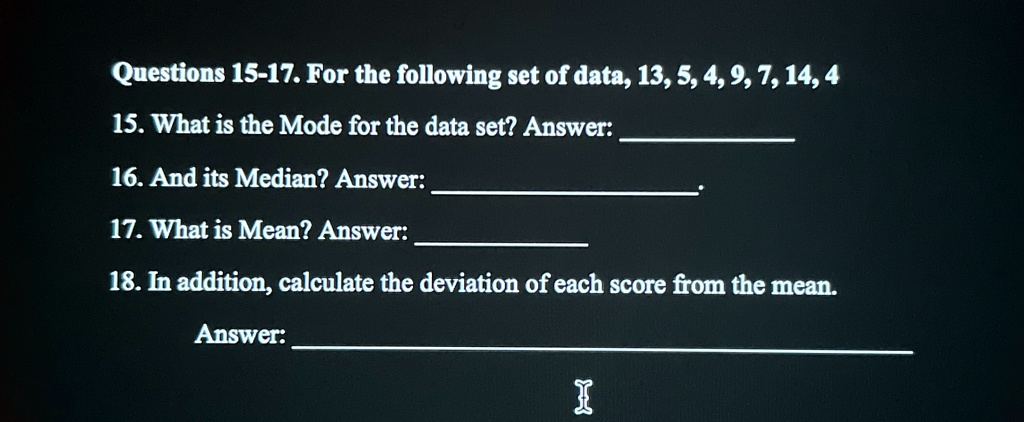
Questions 15-17. For the following set of data, 13, 5, 4, 9, 7, 14, 4 15. What is the Mode for the data set? Answer: 16. And its Median? Answer: 17. What is Mean? Answer: 18. In addition, calculate the deviation of each score from the mean. Answer:
\frac{(2x+6+h)-(2x+6)}{h}
The dynamics behavior of a system is described by the equation below: 1. Why this equation represents a free response? 2. If this represents a mass-spring system, what is the value of the spring? 3. What would be the units of x(0) and \(\dot{x}(0)\)? 4. Obtain the response x(t) of the system. Show all the steps to attain full credit. 5. Calculate the natural frequency. 6. What would be \"roughly\" a graph of x(t)? provide the correct amplitude and period. \(\ddot{x} + 3x + = 0, x(0) = 1, \dot{x}(0) = 0\)
New area of health care: health-care professionals exploring the best options.
Use the table below to answer the following questions. Table 2 Output TFC TVC TC (teapots per (dollars per (dollars per (dollars per day) day) day) day) 0 30 0 30 3 30 -- 60 8 30 60 90 12 30 -- -- 15 30 -- 150 16 30 -- 180 6) Refer to Table 2, which gives Tania's Teapots' total cost schedule. The average variable cost of producing 15 teapots is A) $150.. B) $120. C) $8 D) $30. E) $10. 6)
Let F = (4xy, 9y^2) be a vector field in the plane, and C the path y = 5x^2 joining (0,0) to (1, 5) in the plane.\ A. Evaluate \(\int_C \mathbf{F} \cdot d\mathbf{r}\)\ B. Does the integral in part (A) depend on the path joining (0,0) to (1,5)? y (y/n)
Given a rigid tank with $V = 800$ L filled with $m = 2$ kg of $H_2O$ at $P = 0.2$ MPa. Write your answers in the table below. Only answers in the table are counted. Specific volume ($m^3/kg$) = Phase description: Temperature (°C) = The mass of the liquid (kg) = Quality [X] = The mass of the vapor (kg) = The volume occupied by the liquid phase ($m^3$) = The volume occupied by the vapor phase ($m^3$) =