Ace - AI Tutor
Ask Our Educators
Textbooks
My Library
Flashcards
Scribe - AI Notes
Notes & Exams
Download App
Trijal Mathuria

Trijal M.

Divider

Viewed Questions

Quantum mechanics One of the possible wave functions of a particle in the potential well of Fig. $5.17$ is sketched there. Explain why the wavelength and amplitude of $\psi$ vary as they do.

Concepts of Modern Physics

Quantum mechanics Obtain Schrodinger's steady-state equation from Eq. (3.5) with the help of de Broglie's relationship $\lambda=h / m v$ by letting $y=\psi$ and finding $\partial^{2} \psi / \partial x^{2}$.

Concepts of Modern Physics

Quantum mechanics An eigenfunction of the operator $d^{2} / d x^{2}$ is $\sin n x$, where $n$ $=1,2,3, \ldots$ Find the corresponding eigenvalues. of the wave functions for the $n=1$ and $n=2$ states of a particle in a box $L$ wide.

Concepts of Modern Physics

Quantum mechanics Show that the expectation values $\langle p x\rangle$ and $\langle x p\rangle$ are related by $$ \langle p x\rangle-\langle x p\rangle=\frac{\hbar}{i} $$ This result is described by saying that $p$ and $x$ do not commute and it is intimately related to the uncertainty principle.

Concepts of Modern Physics

Questions asked

ANSWERED

Shu Naito verified

Numerade educator

9. A square is revolved about an axis lying in the plane of the square, which intersects the square only at one of its vertices. For what position of the axis, is the volume of the resulting solid of revolution the largest?

View Answer
divider
ANSWERED

Sam Stansfield verified

Numerade educator

8. The curve ( x(t)=2 cos t-cos 2 t, y(t)=2 sin t-sin 2 t, 0 leq t leq pi ) is revolved about ( x )-axis. Calculate the area of the surface generated.

View Answer
divider
ANSWERED

Sam Stansfield verified

Numerade educator

7. Find the area of the surface generated by revolving the curve y = x^3, 0 ? x ? 1/2, about the x-axis.

View Answer
divider
ANSWERED

Willis James verified

Numerade educator

6. Let ( f:[0, infty) ightarrow mathbb{R} ) be a differentiable and increasing function such that ( f(0)=1 ). Let ( s(x) ) denote the length of the curve ( y=f(x) ) from the point ( (0,1) ) to ( (x, f(x)), x>0 ). Suppose ( s(x)=2 x ) for all ( x in[0, infty) ). Evaluate ( f(x) ).

View Answer
divider
ANSWERED

Shu Naito verified

Numerade educator

5. Consider the never ending curves (a) ( r=e^{- heta}, heta in[0, infty) ), (b) ( r=frac{1}{1+ heta}, heta in[0, infty) ). Sketch the curves and show that the length of the curve (a) is finite and of the curve (b) is infinite.

View Answer
divider
ANSWERED

Gregory Higby verified

Numerade educator

Consider a region R as the part of the disk (y-1)^2 + x^2 <= 4, y >= 0. Find the volume of the solid obtained by revolving the region R about the x-axis.

View Answer
divider
ANSWERED

Willis James verified

Numerade educator

4. Let ( f ) be a continuous function on ( mathbb{R} ). Consider the region ( R ) bounded by the curve ( y=f(x) ), the ( x )-axis and the lines ( x=a ) and ( x=b ). A solid is generated by revolving ( R ) about the ( x )-axis. For fixed ( a ), the volume of this solid between the planes ( x=a ) and ( x=b ) is ( left[(b-1)^{3}-(a-1)^{3} ight] ) for each ( b>a ). Find ( f(x) ).

View Answer
divider
INSTANT ANSWER

10. Let \( C \) be a semicircular arc of length 5 cm situated in the first quadrant. The area of the surface generated by revolving \( C \) about \( x \)-axis is \( 30 \mathrm{~cm}^{2} \). And when it is revolved about \( y \)-axis the area of the surface obtained is \( 40 \mathrm{~cm}^{2} \). Find the area of the surface obtained by revolving the same arc \( C \) about the line \( y+x=0 \).

View Answer
divider
ANSWERED

Vincenzo Zaccaro verified

Numerade educator

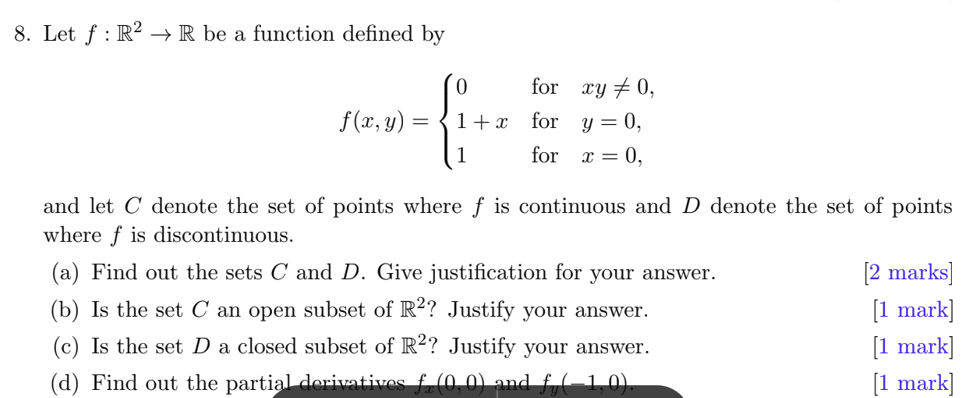
8. Let f : R^2 ? R be a function defined by f(x, y) = { 0 for xy ? 0, 1 + x for y = 0, 1 for x = 0, and let C denote the set of points where f is continuous and D denote the set of points where f is discontinuous. (a) Find out the sets C and D. Give justification for your answer. (b) Is the set C an open subset of R^2? Justify your answer. (c) Is the set D a closed subset of R^2? Justify your answer. (d) Find out the partial derivatives f_x(0, 0) and f_y(-1, 0).
View Answer
divider
ANSWERED

Gregory Higby verified

Numerade educator

7. Let ( R ) be the region bounded by ( y=2 sqrt{x-1} ) and ( y=x-1 ). Find the volume of the solid generated by revolving ( R ) about the line ( x=7 ) using (a) the washer method and (b) the shell method. [2+2 marks]

View Answer
divider