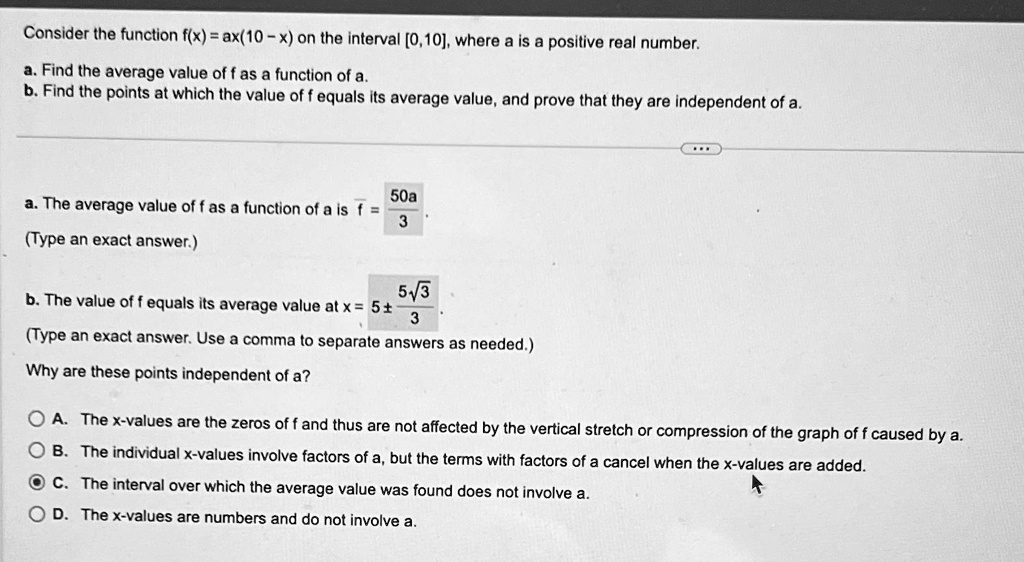
Consider the function f(x)=ax(10-x) on the interval 0,10, where a is a positive real number.
a. Find the average value of f as a function of a.
b. Find the points at which the value of f equals its average value, and prove that they are independent of a.
a. The average value of f as a function of a is /bar (f)=(50a)/(3).
(Type an exact answer.)
b. The value of f equals its average value at x=5+-(5sqrt(3))/(3).
(Type an exact answer. Use a comma to separate answers as needed.)
Why are these points independent of a?
A. The x-values are the zeros of f and thus are not affected by the vertical stretch or compression of the graph of f caused by a.
B. The individual x-values involve factors of a, but the terms with factors of a cancel when the x-values are added.
C. The interval over which the average value was found does not involve a.
D. The x-values are numbers and do not involve a.
Consider the function f(x)=ax(10-x) on the interval [0,10],where a is a positive real number. a.Find the average value of f as a function of a. b. Find the points at which the value of f equals its average value, and prove that they are independent of a
50a a.The average value of f as a function of a is f (Type an exact answer.)
53 b.The value of f equals its average value at x=5 3 (Type an exact answer.Use a comma to separate answers as needed.) Why are these points independent of a?
O A.The x-values are the zeros of f and thus are not affected by the vertical stretch or compression of the graph of f caused by a. O B.The individual x-values involve factors of a, but the terms with factors of a cancel when the x-values are added. O c. The interval over which the average value was found does not involve a. K O D.The x-values are numbers and do not involve a