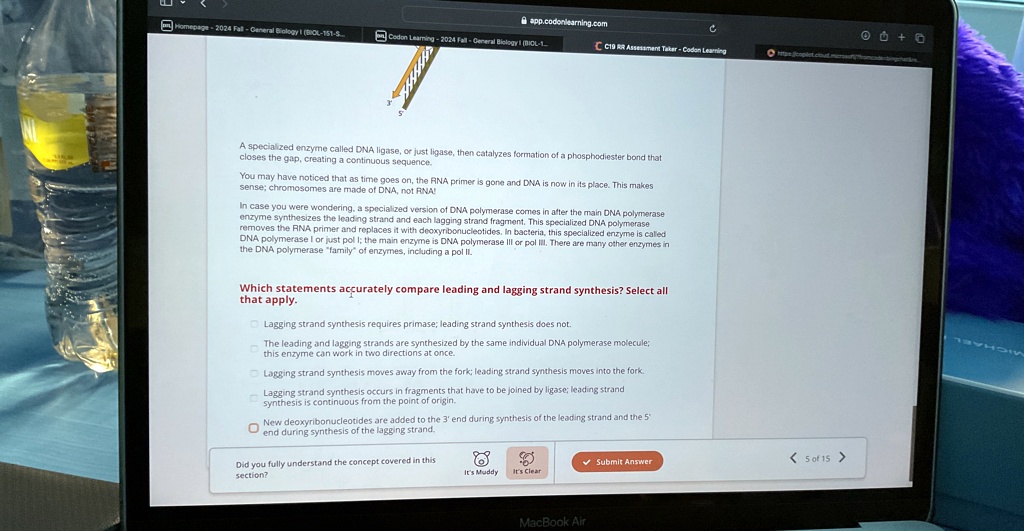
A specialized enzyme called DNA ligase, or just ligase, then catalyzes formation of a phosphodiester bond that
closes the gap, creating a continuous sequence.
You may have noticed that as time goes on, the RNA primer is gone and DNA is now in its place. This makes
sense; chromosomes are made of DNA, not RNA!
In case you were wondering, a specialized version of DNA polymerase comes in after the main DNA polymerase
enzyme synthesizes the leading strand and each lagging strand fragment. This specialized DNA polymerase
removes the RNA primer and replaces it with deoxyribonucleotides. In bacteria, this specialized enzyme is called
DNA polymerase I or just pol I; the main enzyme is DNA polymerase III or rpol III. There are many other enzymes in
the DNA polymerase "family" of enzymes, including a pol II.
Which statements accurately compare leading and lagging strand synthesis? Select all
that apply.
Lagging strand synthesis requires primase; leading strand synthesis does not.
The leading and lagging strands are synthesized by the same individual DNA polymerase molecule;
this enzyme can work in two directions at once.
Lagging strand synthesis moves away from the fork; leading strand synthesis moves into the fork.
Lagging strand synthesis occurs in fragments that have to be joined by ligase; leading strand
synthesis is continuous from the point of origin.
New deoxyribonucleotides are added to the 3' end during synthesis of the leading strand and the 5'
end during synthesis of the lagging strand.
Did you fully understand the concept covered in this
section?
< 5 of 15 >