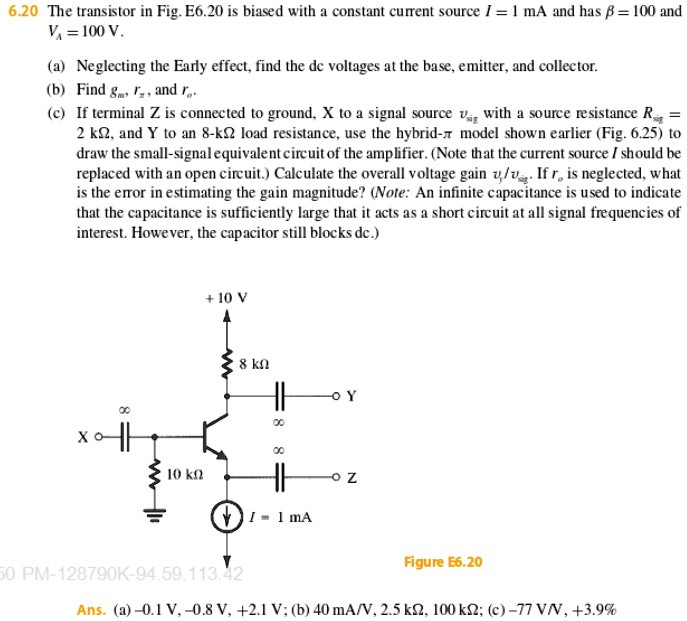
6.20 The transistor in Fig. E6.20 is biased with a constant current source $I = 1 mA$ and has $\beta = 100$ and $V_A = 100 V$.
(a) Neglecting the Early effect, find the dc voltages at the base, emitter, and collector.
(b) Find $g_m$, $r_\pi$, and $r_o$.
(c) If terminal Z is connected to ground, X to a signal source $v_{sig}$ with a source resistance $R_{sig} = 2 k\Omega$, and Y to an 8-$k\Omega$ load resistance, use the hybrid-$\pi$ model shown earlier (Fig. 6.25) to draw the small-signal equivalent circuit of the amplifier. (Note that the current source $I$ should be replaced with an open circuit.) Calculate the overall voltage gain $v_o/v_{sig}$. If $r_o$ is neglected, what is the error in estimating the gain magnitude? (Note: An infinite capacitance is used to indicate that the capacitance is sufficiently large that it acts as a short circuit at all signal frequencies of interest. However, the capacitor still blocks dc.)
Ans. (a) -0.1 V, -0.8 V, +2.1 V; (b) 40 mA/V, 2.5 k$\Omega$, 100 k$\Omega$; (c) -77 V/V, +3.9%