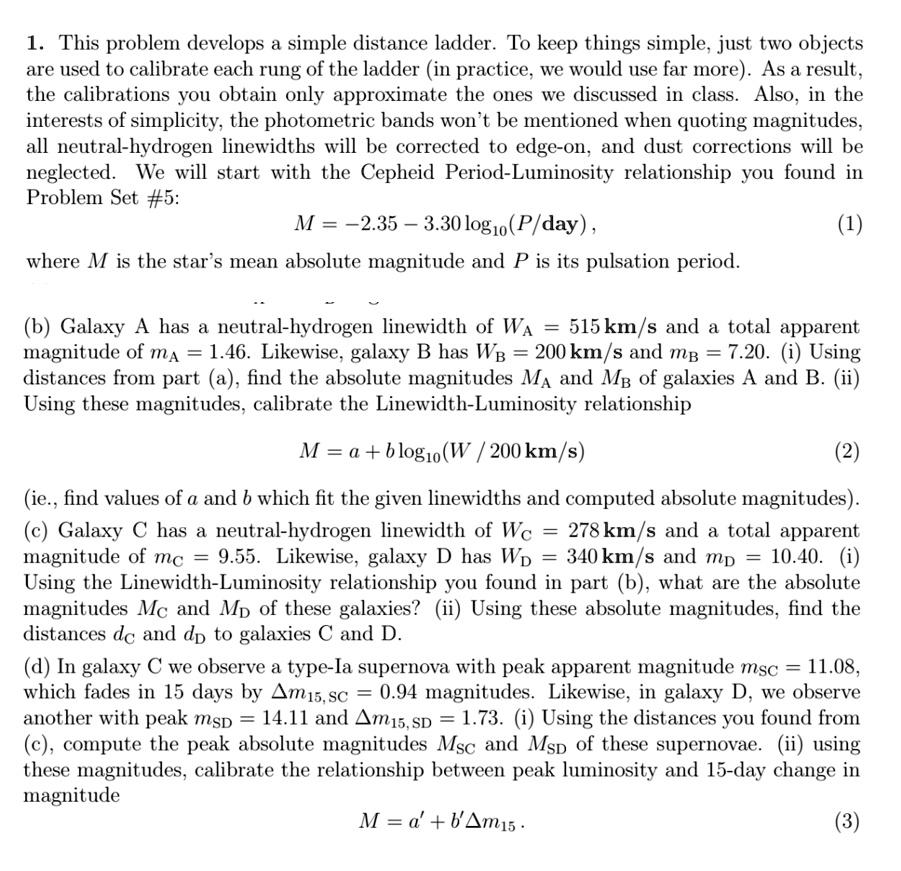
This problem develops a simple distance ladder. To keep things simple, just two objects
are used to calibrate each rung of the ladder (in practice, we would use far more). As a result,
the calibrations you obtain only approximate the ones we discussed in class. Also, in the
interests of simplicity, the photometric bands won't be mentioned when quoting magnitudes,
all neutral-hydrogen linewidths will be corrected to edge-on, and dust corrections will be
neglected. We will start with the Cepheid Period-Luminosity relationship you found in
Problem Set #5:
M=-2.35-3.30log_(10)((P)/( d)ay ),
where M is the star's mean absolute magnitude and P is its pulsation period.
(b) Galaxy A has a neutral-hydrogen linewidth of W_(A)=515k(m)/(s) and a total apparent
magnitude of m_(A)=1.46. Likewise, galaxy B has W_(B)=200k(m)/(s) and m_(B)=7.20. (i) Using
distances from part (a), find the absolute magnitudes M_(A) and M_(B) of galaxies A and B. (ii)
Using these magnitudes, calibrate the Linewidth-Luminosity relationship
M=a+blog_(10)((W)/(200)k(m)/(s))
(ie., find values of a and b which fit the given linewidths and computed absolute magnitudes).
(c) Galaxy C has a neutral-hydrogen linewidth of W_(C)=278k(m)/(s) and a total apparent
magnitude of m_(C)=9.55. Likewise, galaxy D has W_(D)=340k(m)/(s) and m_(D)=10.40. (i)
Using the Linewidth-Luminosity relationship you found in part (b), what are the absolute
magnitudes M_(C) and M_(D) of these galaxies? (ii) Using these absolute magnitudes, find the
distances d_(C) and d_(D) to galaxies C and D.
(d) In galaxy C we observe a type-Ia supernova with peak apparent magnitude m_(SC)=11.08,
which fades in 15 days by Delta m_(15,SC)=0.94 magnitudes. Likewise, in galaxy D, we observe
another with peak m_(SD)=14.11 and Delta m_(15,SD)=1.73. (i) Using the distances you found from
(c), compute the peak absolute magnitudes M_(SC) and M_(SD) of these supernovae. (ii) using
these magnitudes, calibrate the relationship between peak luminosity and 15-day change in
magnitude
M=a^(')+b^(')Delta m_(15).
1. This problem develops a simple distance ladder. To keep things simple, just two objects are used to calibrate each rung of the ladder (in practice,we would use far more). As a result the calibrations you obtain only approximate the ones we discussed in class. Also, in the interests of simplicity, the photometric bands won't be mentioned when quoting magnitudes. all neutral-hydrogen linewidths will be corrected to edge-on. and dust corrections will be neglected. We will start with the Cepheid Period-Luminosity relationship you found in Problem Set #5: M =-2.35 - 3.30 log1o(P/day) (1)
where M is the star's mean absolute magnitude and P is its pulsation period.
b) Galaxy A has a neutral-hydrogen linewidth of WA = 515km/s and a total apparent magnitude of mA = 1.46. Likewise, galaxy B has W = 200 km/s and mB = 7.20. (i) Using distances from part (a), find the absolute magnitudes Ma and Mg of galaxies A and B. (ii) Using these magnitudes, calibrate the Linewidth-Luminosity relationship
M =a+b log1o(W/200 km/s)
(2)
(ie., find values of a and b which fit the given linewidths and computed absolute magnitudes)
(c) Galaxy C has a neutral-hydrogen linewidth of Wc = 278 km/s and a total apparent magnitude of mc = 9.55. Likewise, galaxy D has Wp = 340 km/s and mp = 10.40. (i) Using the Linewidth-Luminosity relationship you found in part (b), what are the absolute magnitudes Mc and Mp of these galaxies? (ii) Using these absolute magnitudes, find the distances dc and dp to galaxies C and D.
(d) In galaxy C we observe a type-Ia supernova with peak apparent magnitude msc = 11.08. which fades in 15 days by m15,sc = 0.94 magnitudes. Likewise, in galaxy D, we observe another with peak msp = 14.11 and Am15,sp = 1.73. (i) Using the distances you found from (c), compute the peak absolute magnitudes Msc and Msp of these supernovae. (ii) using these magnitudes,calibrate the relationship between peak luminosity and 15-day change in magnitude M = a' + b'm15 . (3)