Question 3
We have two random binary signals as input, A and B, which combine through an "exclusive
or" operation to form an output C, i.e., C = A \oplus B.
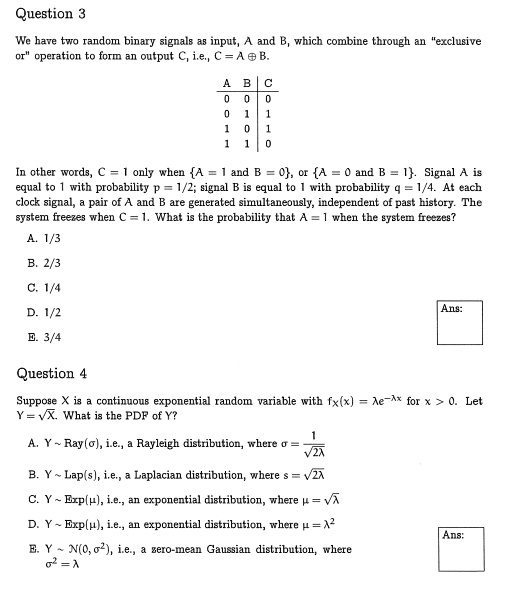
ABC
000
011
101
110
In other words, C = 1 only when {A = 1 and B = 0}, or {A = 0 and B = 1}. Signal A is
equal to 1 with probability p = 1/2; signal B is equal to 1 with probability q = 1/4. At each
clock signal, a pair of A and B are generated simultaneously, independent of past history. The
system freezes when C = 1. What is the probability that A = 1 when the system freezes?
A. 1/3
?. 2/3
C. 1/4
D. 1/2
?. 3/4
Ans:
Question 4
Suppose X is a continuous exponential random variable with $f_X(x) = \lambda e^{-\lambda x}$ for x > 0. Let
Y = $\sqrt{X}$. What is the PDF of Y?
1
A. Y ~ Ray($\sigma$), i.e., a Rayleigh distribution, where $\sigma = \frac{1}{\sqrt{2\lambda}}$
B. Y ~ Lap(s), i.e., a Laplacian distribution, where s = $\sqrt{2\lambda}$
C. Y ~ Exp($\mu$), i.e., an exponential distribution, where $\mu = \sqrt{\lambda}$
D. Y ~ Exp($\mu$), i.e., an exponential distribution, where $\mu = \lambda^2$
Ans:
?. Y ~ N(0, $\sigma^2$), i.e., a zero-mean Gaussian distribution, where
$\sigma^2 = \lambda$