Credit problem
A long steel pipe (k = 16 W/mK) with an inner diameter of 50 mm and an outer
diameter of 60 mm is used to transport superheated vapor in a manufacturing plant.
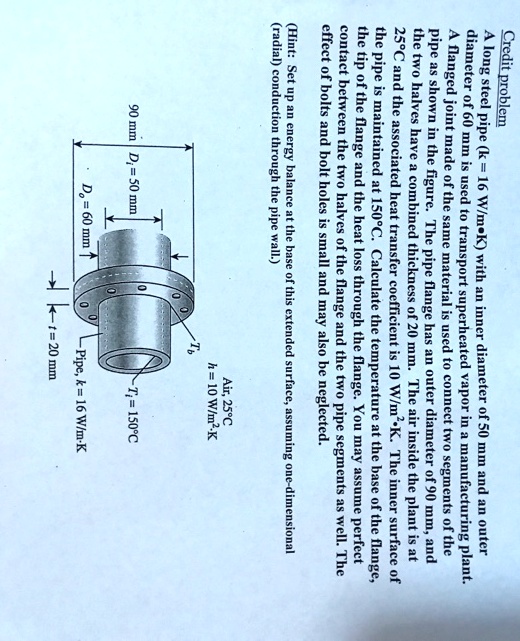
A flanged joint made of the same material is used to connect two segments of the
pipe as shown in the figure. The pipe flange has an outer diameter of 90 mm, and
the two halves have a combined thickness of 20 mm. The air inside the plant is at
25°C and the associated heat transfer coefficient is 10 W/m²K. The inner surface of
the pipe is maintained at 150°C. Calculate the temperature at the base of the flange,
the tip of the flange and the heat loss through the flange. You may assume perfect
contact between the two halves of the flange and the two pipe segments as well. The
effect of bolts and bolt holes is small and may also be neglected.
(Hint: Set up an energy balance at the base of this extended surface, assuming one-dimensional
(radial) conduction through the pipe wall.)
Air, 25°C
h = 10 W/m²-K
??
0
90 mm D? = 50 mm
-T? = 150°C
0
Do = 60 mm?
0
-Pipe, k = 16 W/m-K
t=20 mm