Part III: Competition between Salmon and Trout
5. The salmon and trout are living together in the same waters in the Pacific Northwest. They are both using similar
resources (nutrients, water, prey) but possibly at different stages of their life cycles. In this section we will look at a
model for the competition of two species. Competition may result in reduced fecundity or reduced survivorship. The
Lotka-Volterra model for competition extends the logistic growth model to the case of two competing species.
The Lotka-Volterra model for competition is given by the system of differential equations below. We will let $S(t)$
represent the salmon population at time $t$ and $T(t)$ represent the trout population at time $t$:
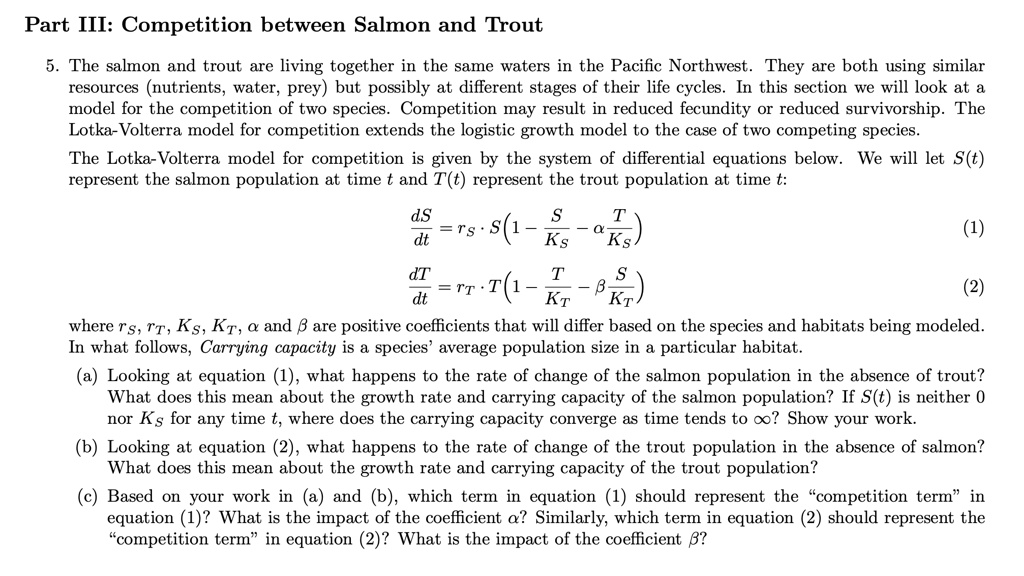
$\frac{dS}{dt} = r_S \cdot S(1 - \frac{S}{K_S} - \alpha \frac{T}{K_S})$
$\frac{dT}{dt} = r_T \cdot T(1 - \frac{T}{K_T} - \beta \frac{S}{K_T})$
(1)
(2)
where $r_S$, $r_T$, $K_S$, $K_T$, $\alpha$ and $\beta$ are positive coefficients that will differ based on the species and habitats being modeled.
In what follows, Carrying capacity is a species' average population size in a particular habitat.
(a) Looking at equation (1), what happens to the rate of change of the salmon population in the absence of trout?
What does this mean about the growth rate and carrying capacity of the salmon population? If $S(t)$ is neither 0
nor $K_S$ for any time $t$, where does the carrying capacity converge as time tends to $\infty$? Show your work.
(b) Looking at equation (2), what happens to the rate of change of the trout population in the absence of salmon?
What does this mean about the growth rate and carrying capacity of the trout population?
(c) Based on your work in (a) and (b), which term in equation (1) should represent the \"competition term\" in
equation (1)? What is the impact of the coefficient $\alpha$? Similarly, which term in equation (2) should represent the
\"competition term\" in equation (2)? What is the impact of the coefficient $\beta$?