10-6
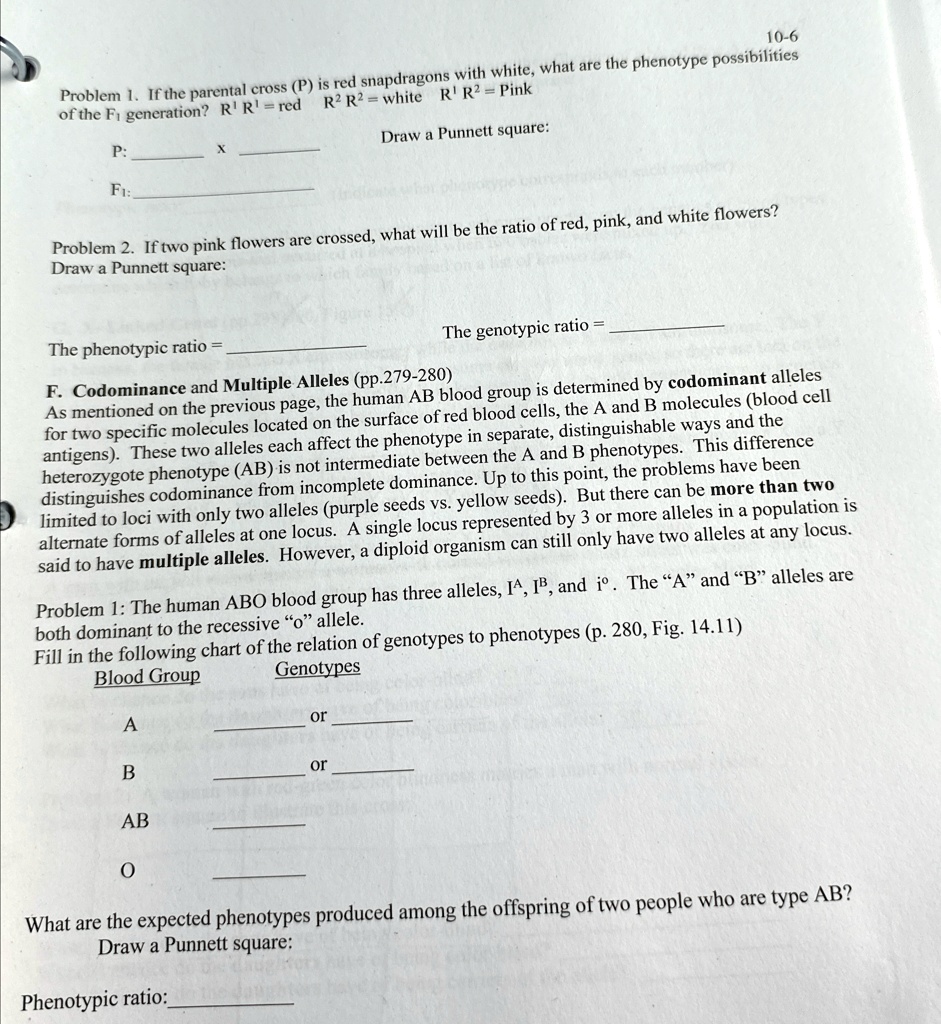
Problem 1. If the parental cross (P) is red snapdragons with white, what are the phenotype possibilities of the F_(1) generation? R^(1)R^(1)= red R^(2)R^(2)= white R^(1)R^(2)= Pink
P : ◻ x ◻ Draw a Punnett square:
F_(1) ◻ Problem 2. If two pink flowers are crossed, what will be the ratio of red, pink, and white flowers?
Draw a Punnett square:
The phenotypic ratio ◻ The genotypic ratio = q,
F. Codominance and Multiple Alleles (pp.279-280)
As mentioned on the previous page, the human AB blood group is determined by codominant alleles for two specific molecules located on the surface of red blood cells, the A and B molecules (blood cell antigens). These two alleles each affect the phenotype in separate, distinguishable ways and the heterozygote phenotype (AB) is not intermediate between the A and B phenotypes. This difference distinguishes codominance from incomplete dominance. Up to this point, the problems have been limited to loci with only two alleles (purple seeds vs. yellow seeds). But there can be more than two alternate forms of alleles at one locus. A single locus represented by 3 or more alleles in a population is said to have multiple alleles. However, a diploid organism can still only have two alleles at any locus.
Problem 1: The human ABO blood group has three alleles, I^(A),I^(B), and i^(0). The "A" and " B " alleles are both dominant to the recessive "o" allele.
Fill in the following chart of the relation of genotypes to phenotypes (p. 280, Fig. 14.11)
Blood Group Genotypes
A ◻ or
B ◻ or
AB ◻
O ◻
What are the expected phenotypes produced among the offspring of two people who are type AB?
Draw a Punnett square:
Phenotypic ratio ◻
10-6
Draw a Punnett square:
P:
F1
Draw a Punnett square:
The genotypic ratio =
The phenotypic ratio E. Codominance and Multiple Alleles (pp.279-280) for two specific molecules located on the surface of red blood cells, the A and B molecules (blood cell antigens). These two alleles each affect the phenotype in separate, distinguishable ways and the heterozygote phenotype (AB) is not intermediate between the A and B phenotypes. This difference distinguishes codominance from incomplete dominance. Up to this point, the problems have been limited to loci with only two alleles (purple seeds vs. yellow seeds). But there can be more than two alternate forms of alleles at one locus. A single locus represented by 3 or more alleles in a population is said to have multiple alleles. However, a diploid organism can still only have two alleles at any locus. Problem 1: The human ABO blood group has three alleles, IA, IB, and io . The "A" and "B" alleles are Fill in the following chart of the relation of genotypes to phenotypes (p.280, Fig. 14.1 1) both dominant to the recessive "o" allele. Blood Group Genotypes A or B or
AB
0
What are the expected phenotypes produced among the offspring of two people who are type AB? Draw a Punnett square:
Phenotypic ratio: