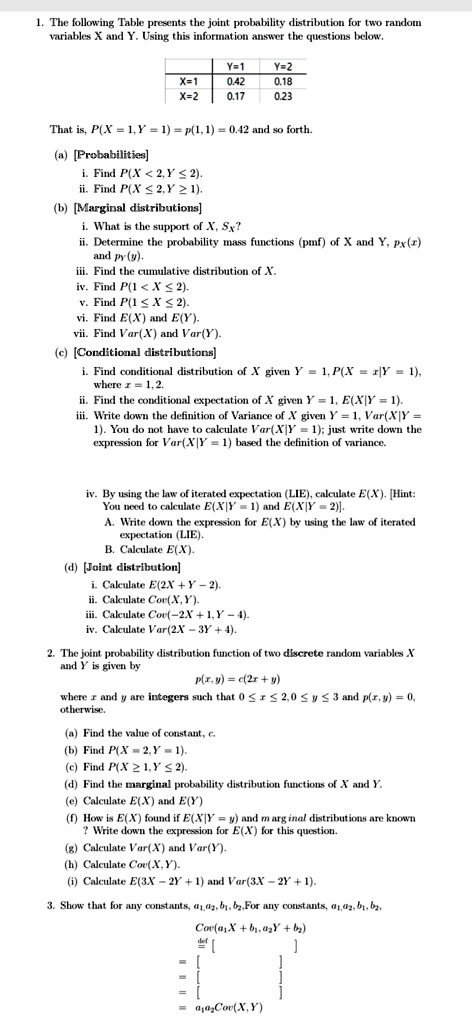
The following Table presents the joint probability distribution for two random variables x and Y. Using this information answer the questions below.
able[[,Y=1,Y=2
1. The following Table presents the joint probability distribution for two random variables X and Y. Using this information answer the questions below.
Y=1 0.42 0.17
Y=2 0.18 0.23
X=1 X=2
(a) [Probabilities] i. Find P(X < 2, Y 2) ii. Find P(X 2, Y 1). b [Marginal distributions] i. What is the support of X, Sx? ii. Determine the probability mass functions (pmf) of X and Y, px() and pr(y. ii. Find the cumulative distribution of X. iv. Find P(1 < X 2). v. Find P(1 X 2). vi. Find E(X) and E(Y). vii. Find Var(X) and Var(Y) (c) [Conditional distributions] i. Find conditional distribution of X given Y = 1,P(X = z|Y = 1. where =1,2. ii. Find the conditional expectation of X given Y = 1, E(X|Y = 1). iii. Write down the definition of Variance of X given Y = 1, Var(X|Y = 1). You do not have to calculate Vr(X|Y = 1); just write down the expression for Vr(X|Y = 1) based the definition of variance.
iv. By using the law of iterated expectation (LIE), calculate E(X). [Hint: You need to calculate E(X|Y = 1) and E(X|Y = 2] A. Write down the expression for E(X) by using the law of iterated expectation (LIE). B. Calculate E(X). (d) [Joint distribution] i. Calculate E(2X + Y 2). ii. Calculate Cor(X,Y). iii. Calculate Cov(2X + 1, Y 4). iv. Calculate Vr(2X 3Y + 4).
2. The joint probability distribution function of two discrete random variables X and Y is given by p(x, y) = c(2x + y) where x and y are integers such that 0 x 2,0 y 3 and p(z, y) = 0, otherwise.
(a) Find the value of constant, c. bFind P(X=2,Y=1 (c Find P(X 1,Y 2 (d) Find the marginal probability distribution functions of X and Y (e Calculate EX and E(Y) (f) How is E(X) found if E(X|Y = y) and m arg inal distributions are known ? Write down the expression for E(X) for this question. (g) Calculate Var(X) and Vr(Y). (h) Calculate Cou(X, Y) (i) Calculate E(3X 2Y + 1) and Vr(3X 2Y + 1).
3. Show that for any constants, ,2,b,b2,For any constants, ,2,b,b2 Cov(aX+b,Y+b)
CorXY