Ace - AI Tutor
Ask Our Educators
Textbooks
My Library
Flashcards
Scribe - AI Notes
Notes & Exams
Download App
tyler stout

tyler s.

Divider

Questions asked

BEST MATCH

Identify the wrong statements in the context of Biot number. (Check all that apply.) Check All That Apply A small Biot number represents small resistance to heat conduction. The smaller the Biot number, the more accurate the lumped system analysis. The Biot number is more likely to be less than 0.1 when a body is cooled using a fan. The Biot number is inversely proportional to the convection heat transfer coefficient.

View Answer
divider
BEST MATCH

Nakatomi, Incorporated, has sales of $757,000, costs of $316,000, depreciation expense of $41,000, interest expense of $36,000, and a tax rate of 21 percent, and paid out $125,000 in cash dividends. The firm has 75,000 shares of common stock outstanding. a. What is the earnings per share, or EPS, figure? Note: Do not round intermediate calculations and round your answer to 2 decimal places, e.g., 32.16. b. What is the dividends per share figure? Note: Do not round intermediate calculations and round your answer to 2 decimal places, e.g., 32.16. a. Earnings per share b. Dividends per share

View Answer
divider
BEST MATCH

If the proceeds on a 19-day simple discount loan is $2,466 and the weekly simple discount rate is 1%, how much was returned? Round your answer to the nearest dollar.

View Answer
divider
BEST MATCH

Variation: D Question 2 out of 14 Consider the following passage: The COVID vaccine is designed to provide immunity against respiratory disease. As of 2023, over 13 billion doses of the COVID vaccines have been administered globally. Is this an argument, or something else? Argument Fight Description Submit

View Answer
divider
BEST MATCH

Program-data dependence refers to the coupling of data stored in files and the specific programs required to update and maintain those files such that changes in programs require changes to the data. Question 74 options: True False

View Answer
divider
BEST MATCH

Given the following LTI continuous-time system below: x y( h() where the impulse response is given as h1=e-2(1-3u13 Given x=ut-2-u-4determine the convolution integral using the specified steps: xy=y+x=n (20 points) a.plot +2n2n=xpu-2n-=2y b.plot x(-r) and label t at the location of the origin c.Perform the convolution integral

View Answer
divider
BEST MATCH

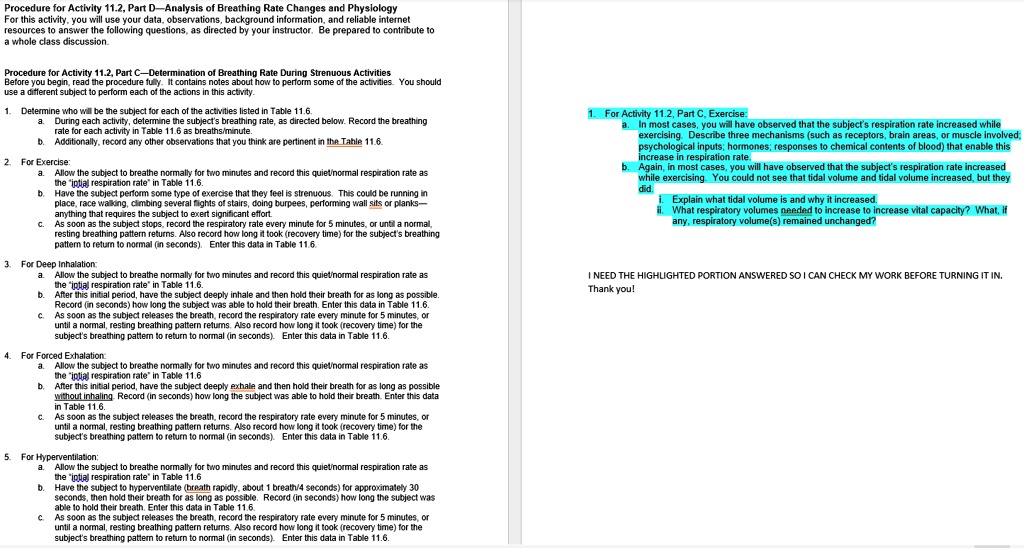
Procedure for Activity 11 Part D - Analysis of Breathing Rate Changes and Physiology For this activity, you will use your data, observations, background information, and reliable internet resources to answer the following questions, as directed by your instructor. Be prepared to contribute to a whole class discussion. Procedure for Activity 11.2, Part C - Determination of Breathing Rate During Strenuous Activities Before you begin, read the procedure fully. It contains notes about how to perform some of the activities. You should use a different subject to perform each of the actions in this activity. Determine who will be the subject for each of the activities listed in Table 11.6. During each activity, determine the subject's breathing rate, as directed below. Record the breathing rate for each activity in Table 11.6 as breaths/minute. Additionally, record any other observations that you think are pertinent in Table 11.6. 1. For Activity 11.2, Part C - Exercise: a. In most cases, you will have observed that the subject's respiration rate increased while exercising. Describe three mechanisms (such as receptors, brain areas, or muscles involved psychological inputs; hormones; responses to chemical contents of blood) that enable this increase in respiration rate. b. Again, in most cases, you will have observed that the subject's respiration rate increased while exercising. You could not see that tidal volume and tidal volume increased, but they aid. Explain what tidal volume is and why it increased. i. What respiratory volumes need to increase to increase vital capacity? What, if any, respiratory volume(s) remained unchanged? For Exercise: Allow the subject to breathe normally for two minutes and record this quiet/normal respiration rate as 0. Place, race waking, climbing several flights of stairs, doing burpees, performing wallsits or planks - anything that requires the subject to exert significant effort. As soon as the subject stops, record the respiratory rate every minute for 5 minutes, or until a normal, resting breathing pattern returns. Also record how long it took (recovery time) for the subject's breathing pattern to return to normal in seconds. Enter this data in Table 11.6. For Deep Inhalation: Allow the subject to breathe normally for two minutes and record this quiet/normal respiration rate as the initial respiration rate in Table 11.6. After this initial period, have the subject deeply inhale and then hold their breath for as long as possible. Record (in seconds) how long the subject was able to hold their breath. Enter this data in Table 11.6. For Forced Exhalation: Record the initial respiration rate in Table 11.6. After this initial period, have the subject deeply exhale and then hold their breath for as long as possible without inhaling. Record (in seconds) how long the subject was able to hold their breath. Enter this data in Table 11.6. As soon as the subject releases the breath, record the respiratory rate every minute for 5 minutes, or until the subject's breathing pattern returns to normal in seconds. Enter this data in Table 11.6. For Hyperventilation: Allow the subject to breathe normally for two minutes and record this quiet/normal respiration rate as the initial respiration rate in Table 11.6. Have the subject hyperventilate (breathe rapidly, about 1 breath/4 seconds) for approximately 30 seconds. Record the subject's breathing rate immediately after hyperventilation. Then, record the respiratory rate every minute for 5 minutes, or until the subject's breathing pattern returns to normal in seconds. Enter this data in Table 11.6.
View Answer
divider
BEST MATCH

A 45.91 kg boy is playing rollerblade dodgeball. His rollerblades are frictionless and he is initially at rest. A dodgeball with mass 586.3 g is thrown directly at him and he catches it. After catching the ball, the boy moves with a speed of 0.2586 m/s. With what speed was the dodgeball thrown? (in m/s) A: $1.815 \times 10^1$ B: $2.051 \times 10^1$ C: $2.318 \times 10^1$ D: $2.619 \times 10^1$ E: $2.959 \times 10^1$ F: $3.344 \times 10^1$ G: $3.779 \times 10^1$ H: $4.270 \times 10^1$

View Answer
divider
BEST MATCH

Consider the liner transformation $T: \mathbb{R}^2 \rightarrow \mathbb{R}^2$ given by $T(u_1) = v_1$ and $T(u_2) = v_2$, for \begin{align*} u_1 = \begin{bmatrix} 1 \ 3 \end{bmatrix}, u_2 = \begin{bmatrix} 2 \ 7 \end{bmatrix}, v_1 = \begin{bmatrix} 1 \ 1 \end{bmatrix}, v_2 = \begin{bmatrix} 3 \ 1 \end{bmatrix}. \end{align*} Find the standard matrix for $T$.

View Answer
divider
BEST MATCH

(Net present value calculation) Big Steve's, makers of swizzle sticks, is considering the purchase of a new plastic stamping machine. This investment requires an initial outlay of $105,000 and will generate net cash inflows of $21,000 per year for 8 years. a. What is the project's NPV using a discount rate of 9 percent? Should the project be accepted? Why or why not? b. What is the project's NPV using a discount rate of 14 percent? Should the project be accepted? Why or why not? c. What is this project's internal rate of return? Should the project be accepted? Why or why not? a. If the discount rate is 9 percent, then the project's NPV is, $ (Round to the nearest dollar.)

View Answer
divider