Ace - AI Tutor
Ask Our Educators
Textbooks
My Library
Flashcards
Scribe - AI Notes
Notes & Exams
Download App
tyrone santiago

tyrone s.

Divider

Questions asked

BEST MATCH

The hormone that is responsible for the heavy buildup of the endometrium and glycogen deposits in the post ovulatoryb phase is HCG Estrogen LH Progesterone

View Answer
divider
BEST MATCH

The orbicularis oculi ______. elevates the upper eyelid closes the eye constricts the opening of the mouth raises the corner of the mouth

View Answer
divider
BEST MATCH

Submit Answer 13. [-/10 Points) DETAILS SCALCET9 6.XP.2.013.MI.SA. MY NOTES ASK YOUR TEACHER PRACTICE ANOTHER This question has several parts that must be completed sequentially. If you skip a part of the question, you will not receive any points for the skipped part, and you will not be able to come back to the skipped part. Tutorial Exercise Find the volume $V$ of the solid obtained by rotating the region bounded by the given curves about the specified line. $y = \ln(2x)$, $y = 2$, $y = 4$, $x = 0$; about the $y$-axis Sketch the region. Sketch the solid and a typical disk or washer. Click here to begin! Need Help? Submit Answer Read

View Answer
divider
BEST MATCH

In Datasheet view of the Workshops table, use Filter by Form to select all records with a WorkshopDate value less than or equal to 5/1/2017.

View Answer
divider
BEST MATCH

Results and Discussion - Experiment 6 - Electrochemistry A. Preparation of battery. 1. Voltage 2. Write the half reactions and overall reaction for the Zn|Zn<sup>2+</sup>||Cu<sup>2+</sup>|Cu cell and calculate the cell potential from standard reduction potentials. B. Determination of Avogadro's number using electrolysis. run 1 run 2 run 3 1. Mass of copper anode 2. Mass of copper cathode 3. Initial current reading 4. Final current reading 5. Average current reading 6. Time for run in seconds 7. Final mass of anode 8. Final mass of cathode 9. Mass loss of anode 10. Mass gained by cathode 11. Moles of Cu lost by anode 12. Moles of Cu gained by cathode 13. Coulombs used (use average current)

View Answer
divider
BEST MATCH

4. Calculate the value of normal stresses and strains in SI units along the (i) longitudinal direction and (ii) transverse direction. A compressive force of 200 lbs along longitudinal axis. A tangential force of 10 N is also acting on the surface. The surface area is 10 mm². (5 marks)

View Answer
divider
BEST MATCH

Problem 10 print("Problem 10") • Ask the user if they are an in-state or out-of-state resident. • Ask the user how many credits they are taking. Print the total cost of tuition per the chart below. Undergraduate Rates Full-time (12 - 19 credits): Flat-rate per semester Resident Status Tuition Mandatory Fees Total In-State 5,379.00 1,107.00 6,486.00 Out-of-State 9,075.00 1,107.00 10,182.00 Part-time (less than 12 credits): Per-credit rate Resident Status Tuition Mandatory Fees Total In-State 418.08 76.59 494.67 Out-of-State 648.80 76.59 725.39

View Answer
divider
BEST MATCH

Question 2 Not yet answered The Mach number of an aircraft that travels with a speed of 200 m/s in air at 23° C while it undergoes the compressibility effect will be: (Use speed of sound in air at 0° C: 331 m/s) Marked out of 1 Flag question Select one: a. M = 0.58 b. M = 0.69 c. M = 0.78

View Answer
divider
BEST MATCH

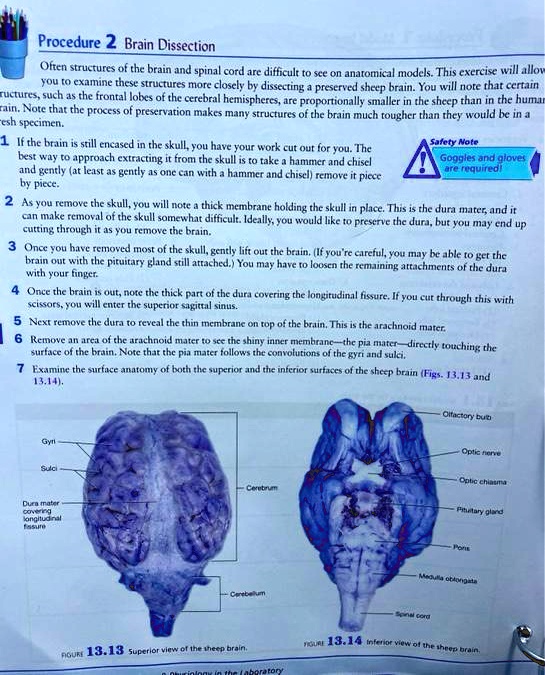
Procedure 2 Brain Dissection Often structures of the brain and spinal cord are difficult to see on anatomical models. This exercise will allow you to examine these structures more closely by dissecting a preserved sheep brain. You will note that certain ructures, such as the frontal lobes of the cerebral hemispheres, are proportionally smaller in the sheep than in the human rain. Note that the process of preservation makes many structures of the brain much tougher than they would be in a resh specimen. 1 If the brain is still encased in the skull, you have your work cut out for you. The best way to approach extracting it from the skull is to take a hammer and chisel and gently (at least as gently as one can with a hammer and chisel) remove it piece by piece. Safety Note Goggles and gloves are required! 2 As you remove the skull, you will note a thick membrane holding the skull in place. This is the dura mater, and it can make removal of the skull somewhat difficult. Ideally, you would like to preserve the dura, but you may end up cutting through it as you remove the brain. 3 Once you have removed most of the skull, gently lift out the brain. (If you're careful, you may be able to get the brain out with the pituitary gland still attached.) You may have to loosen the remaining attachments of the dura with your finger. 4 Once the brain is out, note the thick part of the dura covering the longitudinal fissure. If you cut through this with scissors, you will enter the superior sagittal sinus. 5 Next remove the dura to reveal the thin membrane on top of the brain. This is the arachnoid mater. 6 Remove an area of the arachnoid mater to see the shiny inner membrane-the pia mater-directly touching the surface of the brain. Note that the pia mater follows the convolutions of the gyri and sulci. 7 Examine the surface anatomy of both the superior and the inferior surfaces of the sheep brain (Figs. 13.13 and 13.14).
View Answer
divider
BEST MATCH

9) Assume that A melts at 140 °C, B melts at 220 °C, and a 1:1 mixture of A and B forms a eutectic that melts at 100 °C. What is the composition of the liquid above the solid when 33% of a mixture containing 20% A and 80% has melted? (a) pure A; (b) pure B; (c) 33% A and 67% B; (d) 50% A and 50 % B

View Answer
divider