Ace - AI Tutor
Ask Our Educators
Textbooks
My Library
Flashcards
Scribe - AI Notes
Notes & Exams
Download App
icpt qfe

icpt q.

Divider

Viewed Questions

An electric dipole of dipole moment $\mathbf{p}$, fixed in direction, is located at a position $\mathbf{r}_{0}(t)$ with respect to the origin. Its velocity $\mathbf{y}=d \mathbf{r}_{0} / d t$ is nonrelativistic. (a) Show that the dipole's charge and current densities can be expressed formally as $$ \rho(\mathbf{x}, t)=-(\mathbf{p} \cdot \nabla) \delta\left(\mathbf{x}-\mathbf{r}_{0}(t)\right) ; \quad \mathbf{J}(\mathbf{x}, t)=-\mathbf{v}(\mathbf{p} \cdot \mathbf{\nabla}) \delta\left(\mathbf{x}-\mathbf{r}_{0}(t)\right) $$ (b) Show that the off-center moving dipole gives rise to a magnetic dipole field and an electric quadrupole field in addition to an electric dipole field, with moments $$ m=\frac{1}{2} \mathbf{p} \times \mathbf{v} $$ and $$ Q_{u}=3\left(x_{0} p_{j}+x_{0} p_{i}\right)-2 \mathbf{r}_{0} \cdot \mathbf{p} \delta_{i j} $$ [There are, of course, still higher moments.] (c) Show that the quasi-static electric quadrupole field is $$ \mathbf{E}(\mathbf{x})=\frac{1}{4 \pi \epsilon_{0}} \frac{1}{r^{4}}\left[15 \mathbf{n}\left(\mathbf{n} \cdot \mathbf{r}_{0}\right)(\mathbf{n} \cdot \mathbf{p})-3 \mathbf{r}_{0}(\mathbf{n} \cdot \mathbf{p})-3 \mathbf{p}\left(\mathbf{n} \cdot \mathbf{r}_{0}\right)-3 \mathbf{n}\left(\mathbf{r}_{0}+\mathbf{p}\right)\right] $$ where $\mathrm{n}$ is a unit vector in the radial direction.

Classical Electrodynamics

Questions asked

INSTANT ANSWER

(4) The object Cygnus X-1 is extremely bright in X-rays, but invisible in optical telescopes. It appears to be very near a 40 solar mass star called HDE 226868, which shows a Doppler shift that oscillates with a 5.6 day period and maximum velocity \( 76 \mathrm{~km} / \mathrm{sec} \). Assuming that Cygnus X-1 and HDE 226868 execute circular orbits about their common center of mass, and that orbit is viewed edge on, find the mass of Cygnus X-1. There is evidence that the orbit is inclined at an angle of \( 30^{\circ} \) (instead of \( 90^{\circ} \) for edge-on). What is the mass in this case? What do you think Cygnus X-1 is? From time to time in this course, I will encourage you to look at journal articles regarding some subjects. In this case, you might look at one of the original "discovery" papers, namely Cygnus X-1 - a Spectroscopic Binary with a Heavy Companion?, by Louise Webster and Paul Murdin, Nature 235(07 January 1972)37.

View Answer
divider
INSTANT ANSWER

Consider a system of \( N \) non-interacting particles, in which the energy of each particle can assume the value of either \( \epsilon_{0} \) and \( \epsilon_{1} \). Assume that \( \epsilon_{1}>\epsilon_{0} \). The total number of particles with energy \( \epsilon_{0} \) is denoted by \( N_{0} \) and the total number of particles with energy \( \epsilon_{1} \) is denoted by \( N_{1} \). The total energy of the system is constant and has the value \( U \). (i) Determine the entropy \( S(U, N) \) in terms of \( N_{0} \) and \( N_{1} \) when the \( N \) 's is sufficiently large so that Sterling's approximation is valid. (ii) Express \( U \) in terms of \( N_{1} \). Find the temperature \( T \) as a function of \( N \) and either \( U \) or equivalently \( N_{1} \). (iii) For what range of values of \( N_{1} \) is \( T<0 \). (iv) If a system with positive temperature is brought into thermal contact with the system at negative temperature, in which direction will heat flow? Explain the logical basis of your answer.

View Answer
divider
INSTANT ANSWER

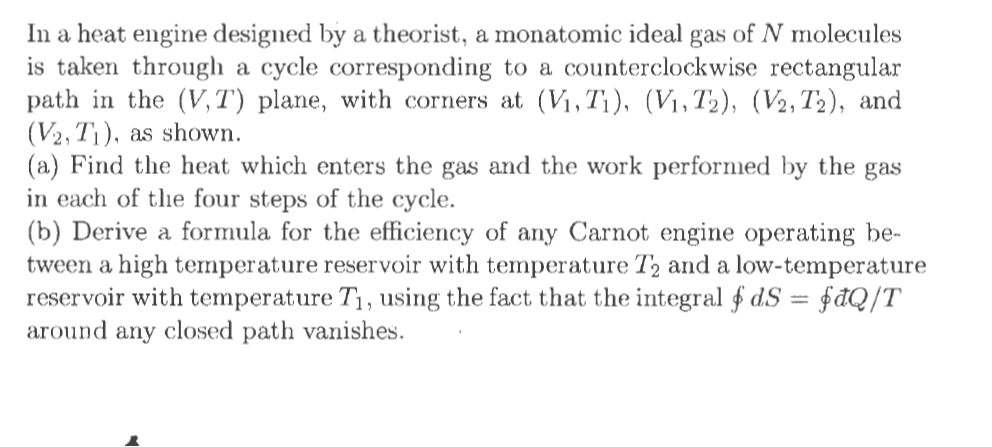
In a heat engine designed by a theorist, a monatomic ideal gas of \( N \) molecules is taken through a cycle corresponding to a counterclockwise rectangular path in the \( (V, T) \) plane, with corners at \( \left(V_{1}, T_{1}\right),\left(V_{1}, T_{2}\right),\left(V_{2}, T_{2}\right) \), and \( \left(V_{2}, T_{1}\right) \), as shown. (a) Find the heat which enters the gas and the work performed by the gas in each of the four steps of the cycle. (b) Derive a formula for the efficiency of any Carnot engine operating between a high temperature reservoir with temperature \( T_{2} \) and a low-temperature reservoir with temperature \( T_{1} \), using the fact that the integral \( \oint d S=\oint ? Q / T \) around any closed path vanishes.
View Answer
divider
INSTANT ANSWER

Consider an engine working in a reversible cycle which uses an ideal gas with constant heat capacity \( C_{V} \) as the working substance. The cycle consists of two process at constant pressure, joined by two adiabatic ones. (i) Find the efficiency of this engine in terms of \( P_{1} \) and \( P_{2} \). (ii) Among the four temperatures, \( T_{a}, T_{b}, T_{c} \), and \( T_{d} \), which one is the highest and which one is the lowest?

View Answer
divider
INSTANT ANSWER

(ii) Using Hamilton's equations of motion, show that a quantity \( A\left(\left\{p_{i}, q_{i}\right\}\right) \) obeys the Poisson bracket equation of motion \[ \frac{d A}{d t}=\left(\frac{\partial A}{\partial t}\right)+\{A, H\} \] The Cartesian components of the angular momentum \( L_{i} \) satisfy the Poisson bracket relation \[ \left\{L_{1}, L_{2}\right\}=L_{3} \] and its cyclic permutations. The Hamiltonian of an asymmetric top is expressed as \[ H=\sum_{i} \frac{L_{i}^{2}}{2 I_{i}} \] where the \( I_{i} \) are the principal moments of inertia and where \( L_{i} \) are the components of the angular momentum parallel to the principal axes. (iii) Show that equations of motion for an asymmetric top reduce to Euler's equations in the absence of a torque \[ \begin{aligned} I_{1} \dot{\omega}_{1}+\omega_{2} \omega_{3}\left(I_{3}-I_{2}\right) & =0 \\ I_{2} \dot{\omega}_{2}+\omega_{1} \omega_{3}\left(I_{1}-I_{3}\right) & =0 \\ I_{3} \dot{\omega}_{3}+\omega_{1} \omega_{2}\left(I_{2}-I_{1}\right) & =0 \end{aligned} \]

View Answer
divider
INSTANT ANSWER

A solid cylinder of mass \( M \) and radius \( R \) rolls without slipping down an inclined plane with an angle \( \alpha \) above the horizontal. (i) Write down the Lagrangian. (ii) Use the Lagrangian to find the equation of motion. (iii) Find the force of static friction. (iv) If the cylinder starts rolling at height \( h \), what is the speed at the bottom of the plane?

View Answer
divider
INSTANT ANSWER

Positronium is a Coulombic bound state of an electron with a positron (antiparticle of the electron). The spatial ground state \( (L=0) \) can exist in either a "singlet" state with the spins of the electron and positron anti-parallel to one another, or a "triplet" state with the spins parallel to one another. Both states decay by the particle-antiparticle pair annihilating into photons. (i) With reference to the common formulae for the hydrogen atom (which you need not re-derive), what would you expect the binding energy of positronium to be? (ii) It is observed that the singlet state decays into two photons. Explain what this tells you about the intrinsic parity quantum numbers of the positron and electron.

View Answer
divider
INSTANT ANSWER

Determine the kinetic energy of particles in a beam of protons which emits Cherenkov radiation in nitrogen gas at pressures of 50 atmospheres or higher. Nitrogen can be considered as an ideal gas. The index of refraction \( n \) is related to the number density \( N \) of the gas molecules by \[ n^{2}=1+4 \pi \alpha N \] The index of refraction of nitrogen gas at atmospheric pressure is 1.0003 . The proton mass is \( m_{0} c^{2}=938 \mathrm{MeV} \).

View Answer
divider
INSTANT ANSWER

2 In an inertial reference frame \( S_{0} \), an event has space time coordinates \( \left(c t_{0}, x_{0}, y_{0}, z_{0}\right) \). Another frame of reference, \( S_{1} \) moves with a constant velocity \( v_{1} \) along the \( x \) axis with respect to \( S_{0} \). Yet another reference frame, \( S_{2} \) moves with a constant velocity \( v_{2} \) along the \( y \)-axis, with respect to \( S_{1} \). The directions of the Cartesian axes are parallel between the reference frames \( S_{0} \) and \( S_{1} \) and between \( S_{1} \) and \( S_{2} \), and their origins initially coincide. (a) Find the space-time coordinates of the event in \( S_{2} \). (b) Do the Lorentz boosts commute? Can the combined boost be considered as a single Lorentz boost?

View Answer
divider
INSTANT ANSWER

(i) Two events occur at the same point \( x^{\prime} \) at times \( t_{1}^{\prime} \) and \( t_{2}^{\prime} \) in a frame \( \mathrm{S} \), which moves with speed \( v \) relative to the frame \( \mathrm{S} \). What is the spatial separation of the two events measured in \( \mathrm{S} \) ? (ii) Elephants have a gestation period of 21 months. Suppose a freshly impregnated elephant is placed on a spaceship and sent towards a distant space jungle at a speed \( v=0.75 c \), where \( c \) is the speed of light. If we monitor radio transmission from the space ship, how long after the launch might we expect to hear the first squealing trumpet from the newborn calf? (iii) Sketch the space-time diagram [ ct versus x ] for part (ii) showing the elephant's worldline and the worldline of the radio signal.

View Answer
divider