Questions asked
A 8.0-cmcm -long wire is pulled along a U-shaped conducting rail in a perpendicular magnetic field. The total resistance of the wire and rail is 0.33 ΩΩ . Pulling the wire with a force of 1.0 NN causes 3.8 WW of power to be dissipated in the circuit. Part A. What is the speed of the wire when pulled with 1.0 NN ? Part B. What is the strength of the magnetic field?
Select all that apply When an employee works in Year 1 but is paid in Year 2, _____ \\ both an expense and liability are recorded in Year 1 both an expense and cash outflow are recorded in Year 2 there is no cash flow affect in Year 1 there is no income statement affect in Year 2
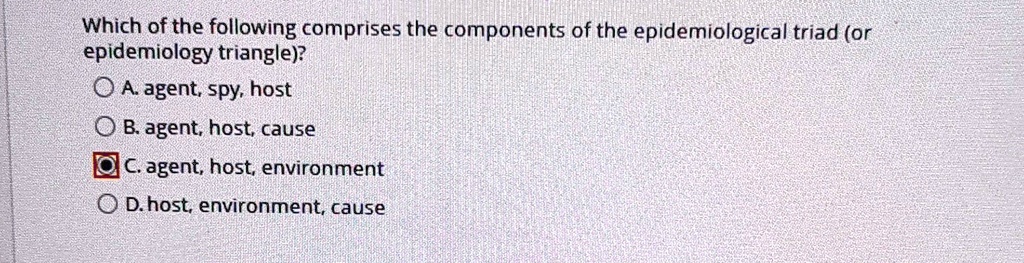
Which of the following comprises the components of the epidemiological triad (or epidemiology triangle)? A. agent, spy, host B. agent, host, cause C. agent, host, environment D. host, environment, cause
What effects can the large deer population have on the nature preserve? SELECT ALL THAT APPLY. Decreased incidence of disease Decreased number of plants Increased incidence of disease Decreased number of other herbivores Increased number of plants Increased number of other herbivores
Initial Knowledge Check Question 14 A student sets up the following equation to convert a measurement. (The ? stands for a number the student is going to calculate.) Fill in the missing part of this equation. $\left(12 \cdot \frac{N}{cm}\right) \square = \frac{N}{mm}$
What push must you exert to give it an acceleration of 1.10 m/s^2
Let $A = \begin{bmatrix} -11 & 6 \\ -28 & 15 \end{bmatrix}$. Find $S$, $D$, and $S^{-1}$ such that $A = SDS^{-1}$. $S = \begin{bmatrix} \Box & \Box \\ \Box & \Box \end{bmatrix}$, $D = \begin{bmatrix} \Box & 0 \\ 0 & \Box \end{bmatrix}$, $S^{-1} = \begin{bmatrix} \Box & \Box \\ \Box & \Box \end{bmatrix}$.
Consider the function $f(x, y) = e^{10x - x^2 - 10y - y^2}$ Find and classify all critical points of the function. If there are more blanks than critical points, leave the remaining entries blank. $f_x = $ $f_y = $ $f_{xx} = $ $f_{xy} = $ $f_{yy} = $
For mutually exclusive events R1, R2, and R3, we have P(R?) = 0.05, P(R2) = 0.3, and P(R3) = 0.65. Also, P (Q | R?) = 0.6, P (Q | R?) = 0.7, and P (Q | R3) = 0.8. Find P (R? | Q). P(R?|Q)=
To what temperature will 8700 J of heat raise 3.0 kg of water that is initially at 10.0°C?