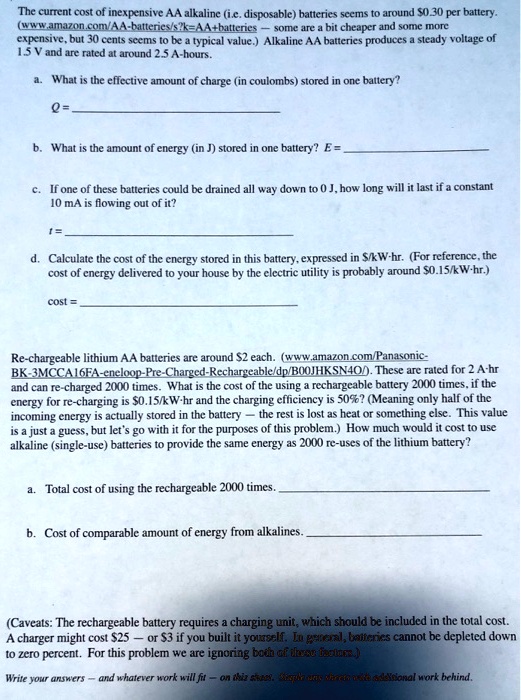
The current cost of inexpensive AA alkaline (i.e. disposable) batteries seems to be around $0.30 per battery. (www.amazon.com/AA-batteries/s?k=AA+batteries) Some are a bit cheaper and some are more expensive. They are 1.5 V and are rated at around 2.5 A-hours.
a. What is the effective amount of charge (in coulombs) stored in one battery?
Q =
b. What is the amount of energy (in J) stored in one battery?
E =
c. If one of these batteries could be drained all the way down to 0 J, how long will it last if a constant 10 mA is flowing out of it?
f =
d. Calculate the cost of the energy stored in this battery, expressed in $/kW-hr. (For reference, the cost of energy delivered to your house by the electric utility is probably around $0.15/kW-hr.)
cost =
Rechargeable lithium AA batteries are around $2 each. (www.amazon.com/Panasonic-BK-3MCCA16FA-eneloop-Pre-Charged-Rechargeable/dp/B00JHKSN4OD) These are rated for 2 A-hr and can be recharged 2000 times. What is the cost of using a rechargeable battery 2000 times, if the energy for recharging is $0.15/kW-hr and the charging efficiency is 50%? (Meaning only half of the incoming energy is actually stored in the battery - the rest is lost as heat or something else. This value is just a guess, but let's go with it for the purposes of this problem.) How much would it cost to use alkaline (single-use) batteries to provide the same amount of energy as 2000 reuses of the lithium battery?
a. Total cost of using the rechargeable battery 2000 times:
b. Cost of a comparable amount of energy from alkalines:
(Caveats: The rechargeable battery requires a charging unit, which should be included in the total cost. A charger might cost $25 or $3 if you built it yourself. In general, batteries cannot be depleted down to zero percent. For this problem, we are ignoring both.)