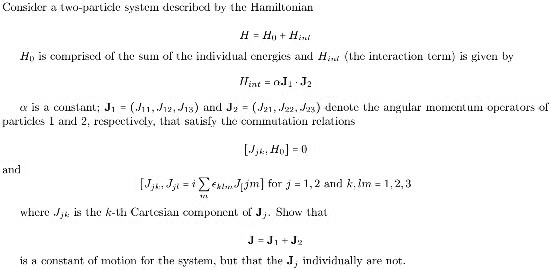
Consider a two-particle system described by the Hamiltonian
$H = H_0 + H_{int}$
$H_0$ is comprised of the sum of the individual energies and $H_{int}$ (the interaction term) is given by
$H_{int} = \alpha \mathbf{J}_1 \cdot \mathbf{J}_2$
$\alpha$ is a constant; $\mathbf{J}_1 = (J_{11}, J_{12}, J_{13})$ and $\mathbf{J}_2 = (J_{21}, J_{22}, J_{23})$ denote the angular momentum operators of
particles 1 and 2, respectively, that satisfy the commutation relations
$[J_{jk}, H_0] = 0$
and
$[J_{jk}, J_{jl}] = i \sum_m \epsilon_{jkl} J_{jm}$ for $j = 1, 2$ and $k, l, m = 1, 2, 3$
where $J_{jk}$ is the $k$-th Cartesian component of $\mathbf{J}_j$. Show that
$\mathbf{J} = \mathbf{J}_1 + \mathbf{J}_2$
is a constant of motion for the system, but that the $\mathbf{J}_j$ individually are not.