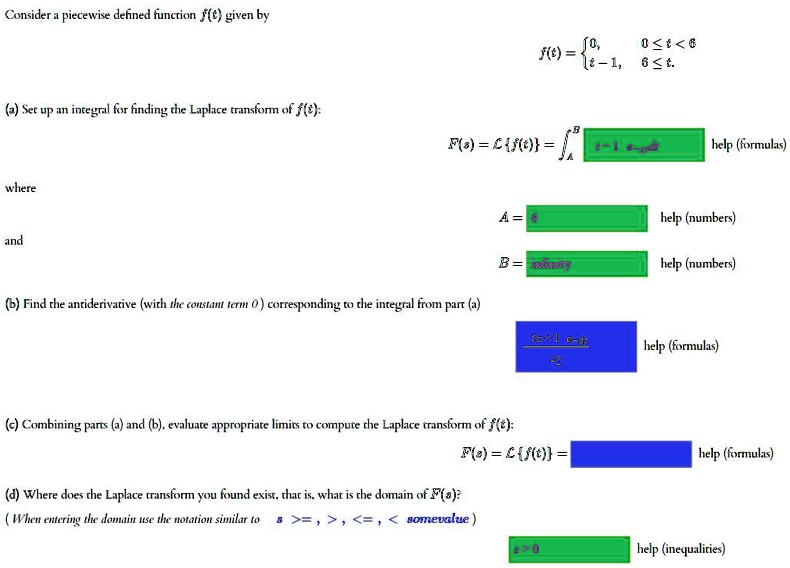
Consider a piecewise defined function $f(t)$ given by
(a) Set up an integral for finding the Laplace transform of $f(t)$:
where
$f(t) = \begin{cases} 0, & 0 < t < 6 \ e^{-1}, & 6 \le t. \end{cases}$
$F(s) = \mathcal{L} \{ f(t) \} = \int_A^B e^{-st} (e^{-1} - 1) dt$
$A = 6$
$B = \infty$
(b) Find the antiderivative (with the constant term 0) corresponding to the integral from part (a)
$\frac{e^{-s t} - 1}{s e^{-s t}}$
(c) Combining parts (a) and (b), evaluate appropriate limits to compute the Laplace transform of $f(t)$:
$F(s) = \mathcal{L} \{ f(t) \} = $
(d) Where does the Laplace transform you found exist, that is, what is the domain of $F(s)$?
(When entering the domain use the notation similar to $s \ge, >, \le, < \text{somevalue}$)
$s > 0$