Advanced Photonics Devices - Quantum Wells and Quantum Dots
Physical constants:
Speed of light, c = 3.00 x 10^8 m/s
Free space permittivity, ε(0) = 8.85 x 10^-12 F/m
Planck's constant, h = 6.63 x 10^-34 J*s
Planck's constant, h = 1.05 x 10^-34 J*s
Electron charge, e = 1.60 x 10^-19 C
Electron mass, m(0) = 9.11 x 10^-31 kg
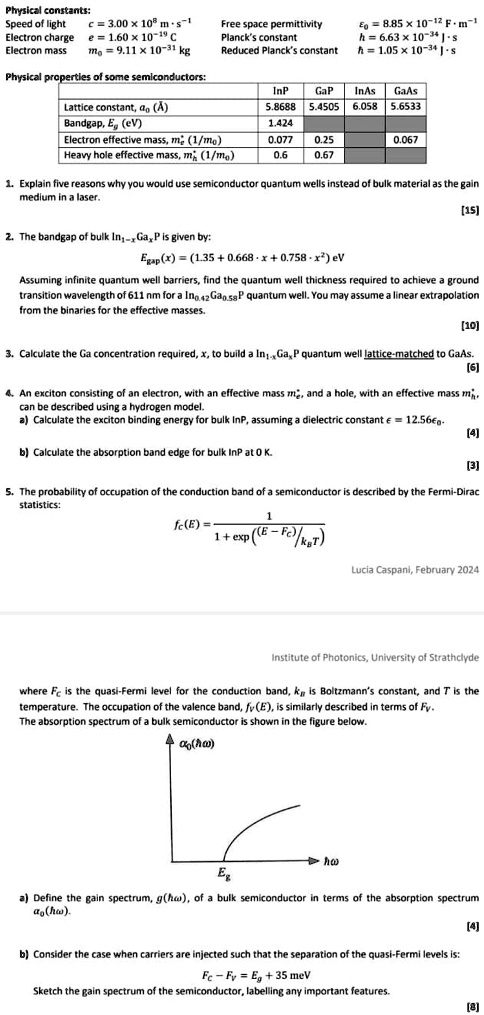
Physical properties of some semiconductors:
Explain five reasons why you would use semiconductor quantum wells instead of bulk material as the gain medium in a laser.
The bandgap of bulk In(1-x)Ga(x)P is given by:
E_gap(x) = (1.35 + 0.668x + 0.758x^2) eV
Assuming infinite quantum well barriers, find the quantum well thickness required to achieve a ground transition wavelength of 611 nm for a In(0.42)Ga(0.58)P quantum well. You may assume a linear extrapolation from the binaries for the effective masses.
Calculate the Ga concentration required, x, to build a In(1*x)Ga(x)P quantum well lattice-matched to GaAs.
An exciton consisting of an electron, with an effective mass m_e^**, and a hole, with an effective mass m_h^**, can be described using a hydrogen model.
a) Calculate the exciton binding energy for bulk InP, assuming a dielectric constant εlon = 12.56εlon(0).
b) Calculate the absorption band edge for bulk InP at 0 K.
Tutorial 2 - Assessed
Deadline for hand-in: Friday, 1st March at 20:00 via MyPlace
Scripts should be submitted via MyPlace on or before the deadline, unless there are extenuating circumstances. Marked scripts will be returned via MyPlace, and worked solutions will be uploaded once all submissions have been handed in.
Solutions can be discussed among students, but the write-up should be done independently. No material should be copied and pasted directly from the lecture notes or any other source.
If you need to find a concentration-dependent parameter, refer to the figure below.
Physical constants:
Speed of light, c = 3.00 x 10^8 m/s
Electron charge = 1.60 x 10^-19 C
Electron mass, m = 9.11 x 10^-31 kg
Free space permittivity
Planck's constant, Reduced Planck's constant
ε = 8.85 x 10^-12 F/m, h = 6.63 x 10^-3 Js, h = 1.05 x 10^-34 Js
Physical properties of some semiconductors:
InP GaP InAs GaAs
Lattice constant A Bandgap E_g eV Electron effective mass, m1/m0 Heavy hole effective mass, m1/m0
5.4505 6.058 5.6533 1.424 0.077 0.25 0.067 0.6 0.67
1. Explain five reasons why you would use semiconductor quantum wells instead of bulk material as the gain medium in a laser. [15]
2. The bandgap of bulk In-GaP is given by E_gap(x) = 1.35 + 0.668x + 0.758x^2 eV. Find the quantum well thickness required to achieve a ground transition wavelength of 611 nm for a In(0.42)Ga(0.58)P quantum well. You may assume a linear extrapolation from the binaries for the effective masses. [10]
3. Calculate the Ga concentration required, x, to build a InGaP quantum well lattice-matched to GaAs. [6]
4. An exciton consisting of an electron, with an effective mass m, and a hole, with an effective mass m, can be described using a hydrogen model.
a) Calculate the exciton binding energy for bulk InP, assuming a dielectric constant = 12.56ε. [4]
b) Calculate the absorption band edge for bulk InP at 0 K. [3]
5. The probability of occupation of the conduction band of a semiconductor is described by the Fermi-Dirac statistics: f_C(E) = ...
Lucia Caspani, February 2024
Institute of Photonics, University of Strathcyde
The absorption spectrum of a bulk semiconductor is shown in the figure below.
a) Define the gain spectrum, g(hω), of a bulk semiconductor in terms of the absorption spectrum α(0)(ℏω). [4]
b) Consider the case when carriers are injected such that the separation of the quasi-Fermi levels is:
F_C - F_V = E_g + 35 meV
Sketch the gain spectrum of the semiconductor, labeling any important features. [8]