Texts:
Question 6:
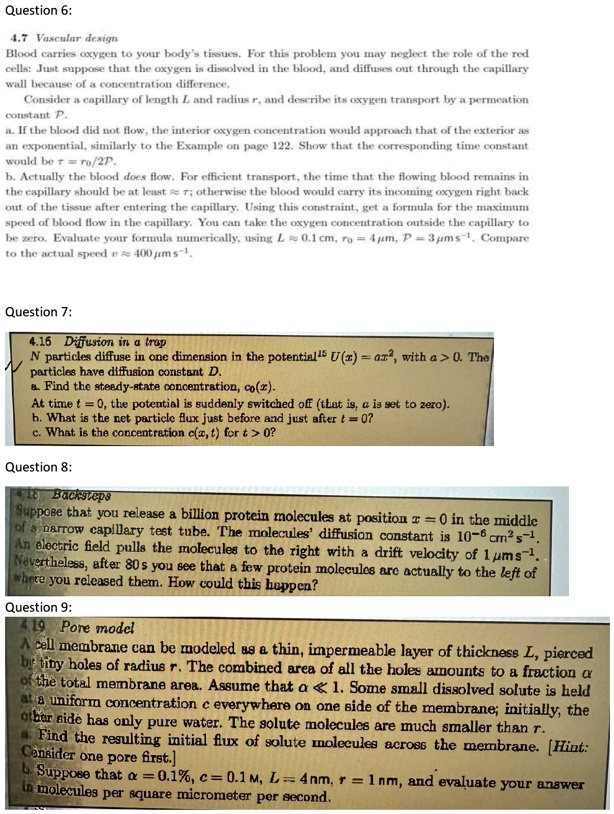
4.7 Vascular design Blood carries oxygen to your body's tissues. For this problem, you may neglect the role of the red cells. Just suppose that the oxygen is dissolved in the blood and diffuses out through the capillary wall because of a concentration difference. Consider a capillary of length L and radius r, and describe its oxygen transport by a permeation constant P.
a. If the blood did not flow, the interior oxygen concentration would approach that of the exterior as an exponential, similarly to the Example on page 122. Show that the corresponding time constant would be = r0/2P.
b. Actually, the blood does flow. For efficient transport, the time that the flowing blood remains in the capillary should be at least R7; otherwise, the blood would carry its incoming oxygen right back out of the tissue after entering the capillary. Using this constraint, get a formula for the maximum speed of blood flow in the capillary. You can take the oxygen concentration outside the capillary to be zero. Evaluate your formula numerically, using L ~ 0.1 cm, r0 = 4 m, P = 3 m s^-1. Compare to the actual speed v = 400 m s^-1.
Question 7:
4.16 Diffusion in a trap N particles diffuse in one dimension in the potential U = ar with a > 0. The particles have a diffusion constant D.
a. Find the steady-state concentration, co.
b. At time t = 0, the potential is suddenly switched off, that is, a is set to zero.
h. What is the net particle flux just before and just after t = 0?
c. What is the concentration c, t for t > 0?
Question 8:
Backsteps Suppose that you release a billion protein molecules at position x = 0 in the middle of a narrow capillary test tube. The molecules' diffusion constant is 10^- cms^-1. An electric field pulls the molecules to the right with a drift velocity of 1 ms^-1. Nevertheless, after 80 s, you see that a few protein molecules are actually to the left of where you released them. How could this happen?
Question 9: 419 Pore model A cell membrane can be modeled as a thin, impermeable layer of thickness L, pierced by tiny holes of radius r. The combined area of all the holes amounts to a fraction of the total membrane area. Assume that a = 1. Some small dissolved solute is held at a uniform concentration c everywhere on one side of the membrane; initially, the concentration on the other side is zero.
Consider one pore first.