Ace - AI Tutor
Ask Our Educators
Textbooks
My Library
Flashcards
Scribe - AI Notes
Notes & Exams
Download App
vanesa wilkinson

vanesa w.

Divider

Questions asked

BEST MATCH

Question 24 (1 point) ✔ Saved Listen The thin myofilament of the skeletal muscles is made of: sarcomere. Z lines. actin. myosin. Question 25 (1 point) Listen ✓ Saved

View Answer
divider
BEST MATCH

19. An electron is moving at a speed of 1.0 km/s perpendicular to a magnetic field with a magnitude of 1.5 T. How much force does the magnetic field exert on the electron?

View Answer
divider
BEST MATCH

Which of the following processes happens during meiosis I? The chromosome number per cell is conserved. Sister chromatids are separated. Four daughter cells are formed. Homologous chromosomes of a pair are separated from each other.

View Answer
divider
BEST MATCH

What town is home to the Clean Water Center? Group of answer choices Walkerton, Ontario Hamilton, Ontario Toronto, Ontario Ottawa, Ontario

View Answer
divider
BEST MATCH

Which two of the following terms are used to describe the telemetry publications? (Choose two.) periodic every so often on-change instantaneous frequent

View Answer
divider
BEST MATCH

XVIII. Suppose a consumer's utility function is given by u(x,y) = Min\{0.5x, 2y\}, where Min is the minimum function. What is the shape of the consumer's indifference curves? a) downward sloping and convex b) linear and downward sloping c) L-shaped (right angle) d) horizontal e) linear and upward sloping

View Answer
divider
BEST MATCH

21. (10 pts) Write a function that takes as input parameters two integer addresses (both call by pointer). It returns the address of a 2-dimensional array. In the function, generate a random number between 5 and 10. That will be the size of the array of addresses (call it x). Then generate a second random number between 4 and 8. That will be the size of each array of integers (call it y). Adjust the input parameters to hold x and y. Create the 2-dimensional array (of x, y in size), making sure the 2-d array is on the heap. Fill this array with 0's. Then generate 5 random number pairs (between 0 and x, and between 0 and y) and place a 1 in each of those random number locations. Make sure that there isn't already a 1 in that location (and if there is generate a new x and y random number set). Return the 2 d array. In the main, use a for loop (looping x times) to call the print function (function 12) to print out the matrix.

View Answer
divider
BEST MATCH

Ext-.2.3 (45 points) For ideal gases, we have shown ΔU = ΔU + RΔT (1) (2) (3) Given the functional relations for the specific heat of carbon dioxide, CO2, ΔU = 55.6 + 30.57*√T (4) where T is in K and ΔU is in kJ/kmol.K. Develop expressions for ΔH and ΔS by starting with equations (2) and (3) and integrating them from a reference temperature. Using the results in part a, develop expressions for ΔH and ΔS assuming constant specific heats. (4 points) Assuming constant specific heat evaluated at 300 K, develop a computer routine (Excel, etc.) that evaluates the following thermodynamic properties for CO2 in the range of temperatures from 300 K to 2000 K. For each property, check the accuracy of your computations at several temperatures, using the data given in the property tables for CO2. (15 points) Using equation 1 in the equations derived in part a, develop formulas that evaluate the following thermodynamic properties for CO2. (10 points) Using your program, generate a table for properties of CO2, showing the values of the properties at a range of temperatures from 300 K to 2000 K. For each property, check the accuracy of your computations at several temperatures, using the data given in the property tables for CO2. (15 points) You must submit a) formulation of the problem for property evaluation; b) program listing; c) program output; and d) a brief discussion of the results.

View Answer
divider
BEST MATCH

What are the main reasons of inflation, and discuss briefly the measures to fight against inflation. Thank you!

View Answer
divider
BEST MATCH

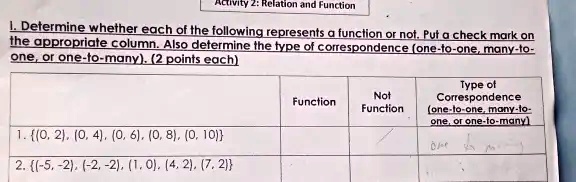
Activity 2: Relation and Function 1. Determine whether each of the following represents a function or not. Put a check mark on the appropriate column. Also determine the type of correspondence (one-to-one, many-to- one, or one-to-many). (2 points each) Function Not Function 1. \{(0, 2), (0, 4), (0, 6), (0, 8), (0, 10)\} 2. \{(-5, -2), (-2, -2), (1, 0), (4, 2), (7, 2)\} Type of Correspondence (one-to-one, many-to- one, or one-to-many)
View Answer
divider