Ace - AI Tutor
Ask Our Educators
Textbooks
My Library
Flashcards
Scribe - AI Notes
Notes & Exams
Download App
vanessa munoz

vanessa m.

Divider

Questions asked

BEST MATCH

You manage a $38 million portfolio, currently all invested in equities, and believe that the market is on the verge of a big but short-lived downturn. You would move your portfolio temporarily into

View Answer
divider
BEST MATCH

For Exercises 31 through 38, assume that two boolean variables named b1 and b2 have been declared and assigned the value true or false earlier in the program. You should also assume that two int variables named a1 and a2 have been declared and assigned some integer value earlier in the program. 31. Where is the error in this code sequence? b1 = a1 && a2; 32. Where is the error in this expression? ( b2 == b1 ) AND ( a1 <= a2 ) 33. Description Where is the logical error in this code sequence? if ( a1 == 4 ); System.out.println( "a1 equal 4" ); 34. Description Where is the error in this code sequence? boolean b1 = true; if b1 System.out.println( "b1 is true" ); 35. Description Where is the error in this code sequence? if { b2 == true } System.out.println( "b2 is true" ); 36. Description Where is the error in this code sequence? if ( b1 == true ) System.out.println( "b1 is true" ); else System.out.println( "b1 is false" ); else if ( a1 < 100 ) System.out.println( "a1 is <= 100" ); 37. Description Is there an error in this code sequence? Explain. if ( b2 == b1 ) System.out.println ("b2 and b1 have the same value"); else if ( a1 == a2 ) System.out.println( "a1 and a2 have the same value" ); else System.out.println( "All variables are different" ); 38. Description Is there an error in this code sequence? Explain. if ( b2 ) System.out.println( "b2 is true" ); else if ( a1 <= 10 || a2 > 50 ) Im trying to understand this stuff better, thank you { System.out.print( "a1 <= 10 or " ); System.out.println( "a2 > 50" ); } else System.out.println( "none of the above" );

View Answer
divider
BEST MATCH

Question 3 Homework • Unanswered • Due Feb 4th, 11:00 AM Mark as: None Which layer will be the ether layer in a separatory funnel containing diethyl ether and a saturated aqueous solution of NaCl? Select an answer and submit. For keyboard navigation, use the up/down arrow keys to select an answer. a The bottom layer. b There will be only one layer because diethyl ether and water are miscible. c The top layer. d It is impossible to tell without testing by adding either water or diethyl ether to the separatory funnel and observing which layer increases in size.

View Answer
divider
BEST MATCH

What is the maximum torque (in N·m) on a 135 turn square loop of wire 18.0 cm on a side that carries a 48.0 A current in a 1.60 T field? N·m (b) What is the torque (in N·m) when 𝜃 is 10.9°? N·m

View Answer
divider
BEST MATCH

x = 5.857

View Answer
divider
BEST MATCH

(x + 7)(x - 6)

View Answer
divider
BEST MATCH

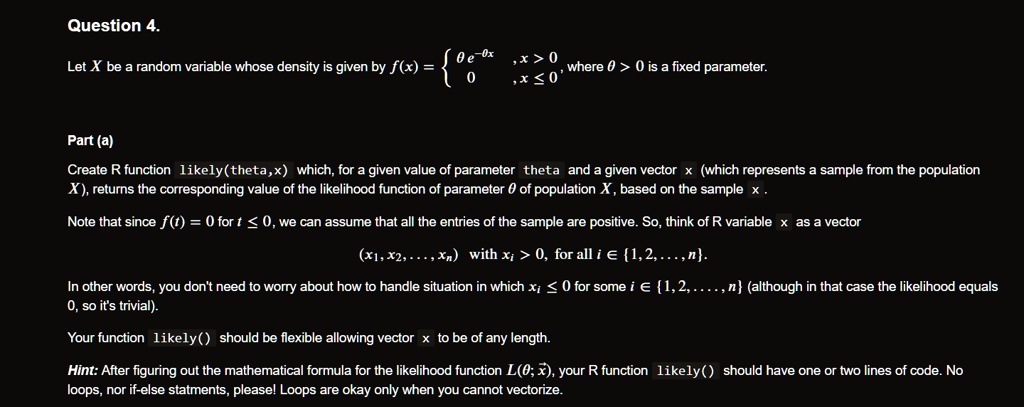
Question 4. Let x be a random variable whose density is given by f(x)={( heta e^(- heta x),x>0),(0,x<=0):}, where heta >0 is a fixed parameter. Part (a) Create R function likely (theta, x ) which, for a given value of parameter theta and a given vector x (which represents a sample from the population x ), returns the corresponding value of the likelihood function of parameter heta of population x, based on the sample x. Note that since f(t)=0 for t<=0, we can assume that all the entries of the sample are positive. So, think of R variable x as a vector (x_(1),x_(2),...,x_(n)) with x_(i)>0, for all i in {1,2,...,n}. In other words, you don't need to worry about how to handle situations in which x_(i)<=0 for some i in {1,2,...,n} (although in that case the likelihood equals 0, so it's trivial). Your function likely() should be flexible allowing vector x to be of any length. Hint: After figuring out the mathematical formula for the likelihood function L( heta ;vec(x)), your R function likely() should have one or two lines of code. No loops, nor if-else statements, please! Loops are okay only when you cannot vectorize.
View Answer
divider
BEST MATCH

Using the titration profile for the titration of Acetic Acid with NaOH, determine the pKa for the weak acid. Acetic Acid Titration Profile 12 10 8 6 4 2 0 0 5 10 15 20 25 30 35 40 Vol Base (mL) 4 3.5 3 2.5 2 1.5 1 0.5 0 1st Derivative

View Answer
divider
BEST MATCH

3. Assume that without Taxes, the consumption schedule for an economy is given by the following table: (6 Points) CLO 5 GDP Tax GDP after Tax Rate Consumption Consumption after Tax 100 200 300 400 500 600 700 120 200 280 360 440 520 600 a) Calculate the MPC. (1.5 Points) b) Assume that a lump-sum tax of $10 billion is imposed at all levels of GDP. Fill columns 2 and 3 of the above table. (3 Points) c) Calculate the Tax rate at each level of GDP. Fill column 4 of the above table. (1.5 Points)

View Answer
divider
BEST MATCH

Referring to the maximum ampere voltage range; the maximum voltage range of the protection devices must exceed or be equal to the maximum AC voltage of the circuit.

View Answer
divider