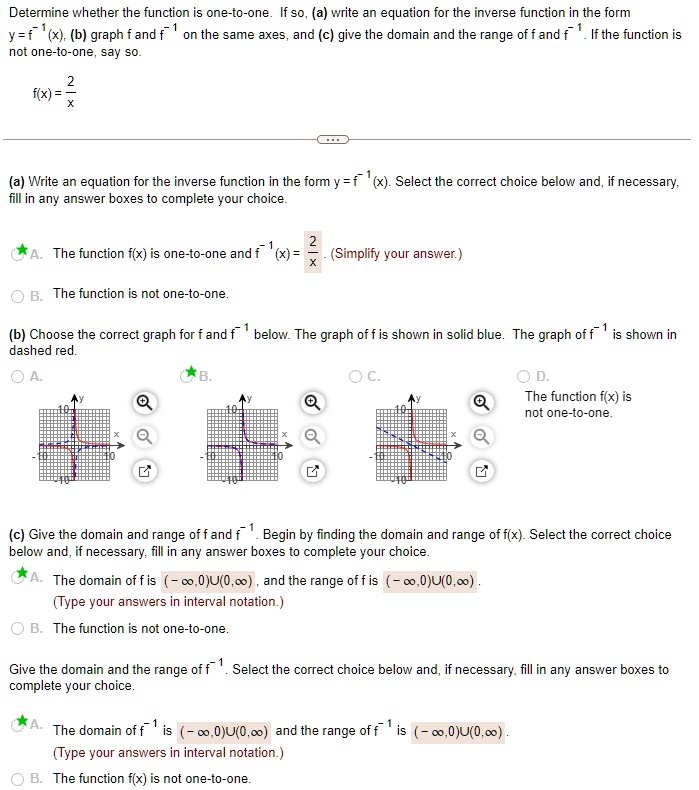
Determine whether the function is one-to-one. If so, (a) write an equation for the inverse function in the form
y=f(x), (b) graph f and f 1 on the same axes, and (c) give the domain and the range of f and f¹. If the function is
not one-to-one, say so.
1
2
f(x) =
X
1
(a) Write an equation for the inverse function in the form y = f (x). Select the correct choice below and, if necessary,
fill in any answer boxes to complete your choice.
2
-1
A. The function f(x) is one-to-one and f(x) =
(Simplify your answer.)
X
B. The function is not one-to-one.
1
1
(b) Choose the correct graph for f and f¹ below. The graph of f is shown in solid blue. The graph of f¹ is shown in
dashed red.
Ο Α.
B.
Q
X
Q
☑
C.
Q
X
Q
☑
D.
Q
The function f(x) is
not one-to-one.
X
Q
1
(c) Give the domain and range of f and f¹. Begin by finding the domain and range of f(x). Select the correct choice
below and, if necessary, fill in any answer boxes to complete your choice.
A. The domain of f is (0,0)U(0,0), and the range of f is (0,0)(0,0).
(Type your answers in interval notation.)
B. The function is not one-to-one.
1
Give the domain and the range of f¹. Select the correct choice below and, if necessary, fill in any answer boxes to
complete your choice.
A. The domain
1
of f¹ is
-1
(-0,0)(0,00) and the range of f is (-00,0)U(0,00).
(Type your answers in interval notation.)
B. The function f(x) is not one-to-one.