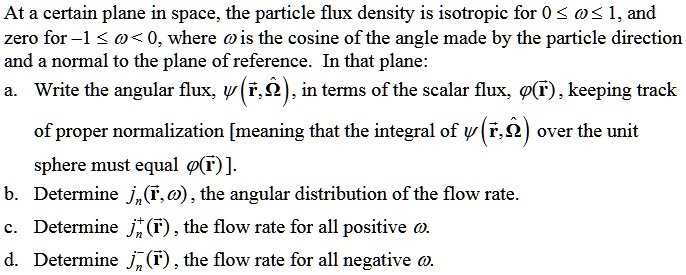
At a certain plane in space, the particle flux density is isotropic for $0 \leq \omega \leq 1$, and \newline zero for $-1 \leq \omega < 0$, where $\omega$ is the cosine of the angle made by the particle direction \newline and a normal to the plane of reference. In that plane: \newline a. Write the angular flux, $\psi(\vec{r}, \vec{\Omega})$, in terms of the scalar flux, $\phi(\vec{r})$, keeping track \newline of proper normalization [meaning that the integral of $\psi(\vec{r}, \vec{\Omega})$ over the unit \newline sphere must equal $\phi(\vec{r})$]. \newline b. Determine $j_n(\vec{r}, \omega)$, the angular distribution of the flow rate. \newline c. Determine $j_n^+(\vec{r})$, the flow rate for all positive $\omega$. \newline d. Determine $j_n^-(\vec{r})$, the flow rate for all negative $\omega$.