Ace - AI Tutor
Ask Our Educators
Textbooks
My Library
Flashcards
Scribe - AI Notes
Notes & Exams
Download App
veronica dunn

veronica d.

Divider

Questions asked

BEST MATCH

1. An inverted T beam of a cross section shown below is subjected at one end to a positive bending moment of 100 kNm applied in a plane parallel to the longitudinal axis but inclined at 45° to the left of vertical. The other end of the beam is completely fixed. The beam has a length of 2.4 m. Determine a. The distribution of normal stress through the depth of the section b. The normal stress distribution plot along the bottom edge of the cross section c. The position of the neutral axis d. The deflections at the tip Assume the Young's modulus of the beam is 70 GPa. 10 mm 80 mm 8 mm 40 mm 80 mm

View Answer
divider
BEST MATCH

ABC company makes a multi-flavour product line that has three products. Data for one of those products, Strawberry Delight, is below. $1,200,000 Annual Sales $930,000 Variable Expenses $360,000 Fixed Expenses -$90,000 Net Loss $60,000 The fixed costs that will remain with elimination of the line. Instructions Prepare an analysis showing whether the company should eliminate the line. State how much money they will gain or lose if the line is eliminated.

View Answer
divider
BEST MATCH

Use the given conditions to write an equation for the line in point­ slope form. Passing through ( − 5, − 5) and parallel to the line whose equation is y = − 5x + 1

View Answer
divider
BEST MATCH

The process of meiosis had not been discovered when Gregor Mendel proposed the law of segregation and law of independent assortment. How do the findings of the process of meiosis confirm what Mendel had proposed in his laws of genetic inheritance?

View Answer
divider
BEST MATCH

Social control theory suggests that deviance occurs when: - a person is labeled as deviant. - a person’s attachment to social bonds is weakened. - a person does not have access to legitimate means of reaching their goals. - social regulations in a society break down.

View Answer
divider
BEST MATCH

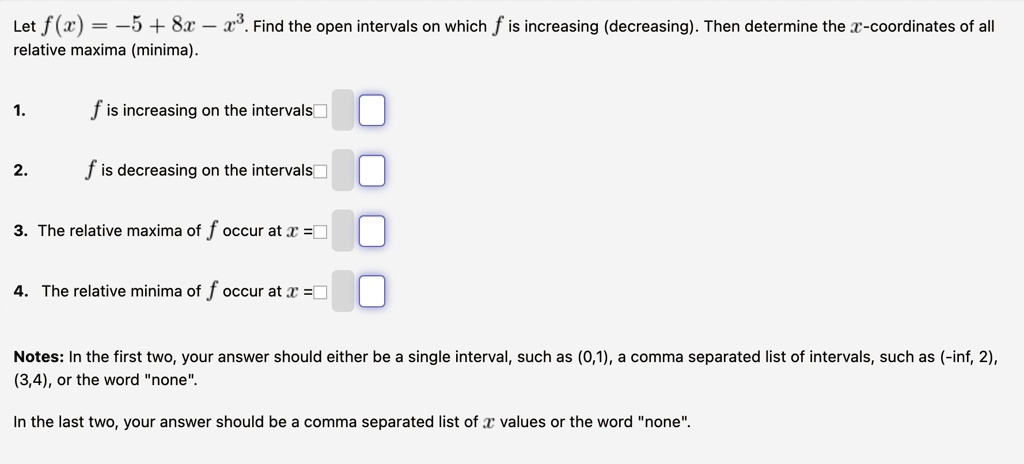
Let $f(x) = -5 + 8x - x^3$. Find the open intervals on which $f$ is increasing (decreasing). Then determine the $x$-coordinates of all relative maxima (minima). 1. $f$ is increasing on the intervals 2. $f$ is decreasing on the intervals 3. The relative maxima of $f$ occur at $x = $ 4. The relative minima of $f$ occur at $x = $ Notes: In the first two, your answer should either be a single interval, such as $(0,1)$, a comma separated list of intervals, such as $(-\inf, 2)$, $(3,4)$, or the word \"none\". In the last two, your answer should be a comma separated list of $x$ values or the word \"none\".
View Answer
divider
BEST MATCH

Q1 Question 1 4 Points Show that the set equation below is not a set identity. $A \cup (B \cap A) = B$ Please select file(s) Select file(s)

View Answer
divider
BEST MATCH

A promisory note agreeing to make 10 payments of £1,810 p.a. commencing in 5 years time is offered for sale now at £11,500, What is the prospective rate of return on this sale? (Ans. = 5%).

View Answer
divider
BEST MATCH

If the same bacteria population continues to grow under ideal conditions for 53 hours, with an initial population size of 36,116 cells, and an intrinsic growth rate of 0.6291. How much time (in minutes) would it take for this population to double in size? (Use 2 decimal places only; e.g., 30.29). Recall that: $N_t = N_0 e^{rt}$ QUESTION 12 A natural population of Poecilia reticulata (guppy) living in a stream in Trinidad has a carrying capacity of 4,296. Its population has changed by 139 individuals over one year, and its initial population size was 174 individuals. What is the maximum per capita rate of population increase? Use four decimal places. Recall that: $\frac{dN}{dt} = N r_{max} (1 - \frac{N}{K}).$

View Answer
divider
BEST MATCH

Give a big-O estimate for the number of operations, where an operation is a comparison or an addtion, used in this segment of an algorithm. Ignore comparisons used to test the conditions in the for loops ($a_1$, $a_2$, ..., $a_n$ are positive real numbers). 1. result := 0 2. for i := 2 to n 3. for j:=i-1 to n 4. result = result + max($a_j$, $a_j$)

View Answer
divider