Ace - AI Tutor
Ask Our Educators
Textbooks
My Library
Flashcards
Scribe - AI Notes
Notes & Exams
Download App
vicenta cabrera

vicenta c.

Divider

Questions asked

BEST MATCH

Q 1) The number of families who used the Minn eapolis YWCA day care service was recorded during a 30-day period. The results are as follows: 31491962244523515560403554265737436518415056454395235516342 a) Construct a cumulative frequency distribution of this data. Note: Round your calculated class interval up to the nearest multiple of 5. b) How many days saw fewer than 30 families utilize the daycare center? c) Based on cumulative relative frequencies, how busy were the highest 80% of the days?

View Answer
divider
BEST MATCH

(Question 3) Let $f(x)$ be a function of period $2\pi$ such that, $f(x) = \begin{cases} x, & 0 < x < \pi \\ \pi, & \pi < x < 2\pi \end{cases}$ (a) Sketch a graph of $f(x)$ in the interval $-2\pi < x < 2\pi$. (5 marks) (b) Determine that the Fourier series for $f(x)$ in the interval of $-2\pi < x < 2\pi$. (20 marks)

View Answer
divider
BEST MATCH

c++ The cube of a number, z, is given by z⁢C⁢u⁢b⁢e⁢d=z3. Declare double variables z and zCubed. Then, read z from input and compute zCubed using the formula. Ex: If the input is 3.80, then the output is: 54.87 Note: z3 can be computed using z * z * z.

View Answer
divider
BEST MATCH

Make sure you truncate your values to 3 decimal places. \begin{tabular}{|c|c|c|c|c|c|} \hline \begin{tabular}{c} \( t \) \\ (years) \end{tabular} & 0 & 10 & 22 & 30 & 37 \\ \hline \begin{tabular}{c} \( N(t) \) \\ (in quadrillion BTUs) \end{tabular} & 12.4 & 21.8 & 20.4 & 19.3 & 22.6 \\ \hline \end{tabular} 4. The function \( N \) represents the total natural gas consumption in the United States, in quadrillions of BTUs, in a given year. The table above gives values of \( N \) for selected values of \( t \), measured in years since 1960 . a) The data in the table can be modeled by the cubic regression function \( y=a x^{3}+b x^{2}+c x+d \). Write the equation of this cubic regression function. b) Based on the model found in part a, what was the predicted natural gas consumption for the US, in quadrillions of BTUs, for the year \( 1967(t=7) \) ?

View Answer
divider
BEST MATCH

A university needs to track students, courses, and the professors who teach those courses. Each student can enroll in multiple courses, and each course can be taught by multiple professors. Which ER model best represents this scenario? a. Students (1) \rightarrow Enrollments (N) \rightarrow Courses (1) \rightarrow Professors (N) b. none of these c. Students (1) \leftrightarrow Professors (M) \leftrightarrow Courses (N) d. Students (M) \leftrightarrow Courses (N) \rightarrow Professors (N) e. Students (N) \rightarrow Courses (M) \rightarrow Professors (1)

View Answer
divider
BEST MATCH

Which of the following is NOT a reason a firm based in one country might choose to get involved abroad? Group of answer choices The industry the firm is in might necessitate going abroad, like the oil industry. Opening factories in foreign countries is typically good for the image of the company in the country in which they are headquartered because it demonstrates a willingness to seek out the best workers to create products. Opening a foreign subsidiary may earn a firm favorable tariff treatment if the subsidiary is in a country which is part of a formal economic community like the European Economic Community. Opening offices abroad may allow a firm to take advantage of skills that aren't as widely available in the country in which they are headquartered.

View Answer
divider
BEST MATCH

Question 20 of 20 View Policies Current Attempt in Progress What acid is formed when the following oxides react with water? Enter the formulas of acids. SO3

View Answer
divider
BEST MATCH

1. Consider a bunch of eggs. The length (cm) of an egg is used as a feature to classify the eggs into either Large (L) or Jumbo (J). The distributions of eggs in each category (length and label) are as follows: Label\Feature (x) 1 2 3 4 5 Large 3 8 6 2 0 Jumbo 0 1 5 9 6 (a) Total number of eggs in this bunch, $N =$ (b) Class distribution: $Pr.\{Large\} =$ $Pr.\{Jumbo\} =$ (c) Likelihood that the length of a large egg is longer than 3 cm: $Pr.\{x > 3|Large\} =$ (d) The a posterior probability that an egg is a jumbo egg given that its length is shorter than 4 cm: $Pr.\{Jumbo | x <4\} =$ (e) $Pr.\{x<4\}=$ (f) $Pr.\{Jumbo, x <4\} =$ (g) Find the likelihood $Pr.\{x <4|Jumbo\} =$ (h) Use above results, verify the Bayesian equation $Pr.\{Jumbo | x <4\} = \frac{Pr.\{x <4|Jumbo\} \cdot Pr.\{Jumbo\}}{Pr.\{x<4\}}$ (i) Consider the Bayesian decision rule (a.k.a. Maximum a Posterior, MAP decision rule) $g(x) = \begin{cases} Large & \text{if } Pr.\{Large|x\} > Pr.\{Jumbo|x\} \\ Jumbo & \text{otherwise.} \end{cases}$ Evaluate $g(x)$ for $x \in \{1, 2, 3, 4, 5\}$ (unit: cm) (j) Using the classifier developed in part (i), evaluate the probability of correct classification:

View Answer
divider
BEST MATCH

8. Consider a project lasting one year only. The initial outlay is $1,000 and the expected inflow is $1,200. The opportunity cost of capital is $r = .20$. The borrowing rate is $r_D = .10$, and the tax shield per dollar of interest is $T_c = .35$. a. What is the project's base-case NPV? b. What is its APV if the firm borrows 30% of the project's required investment?

View Answer
divider
BEST MATCH

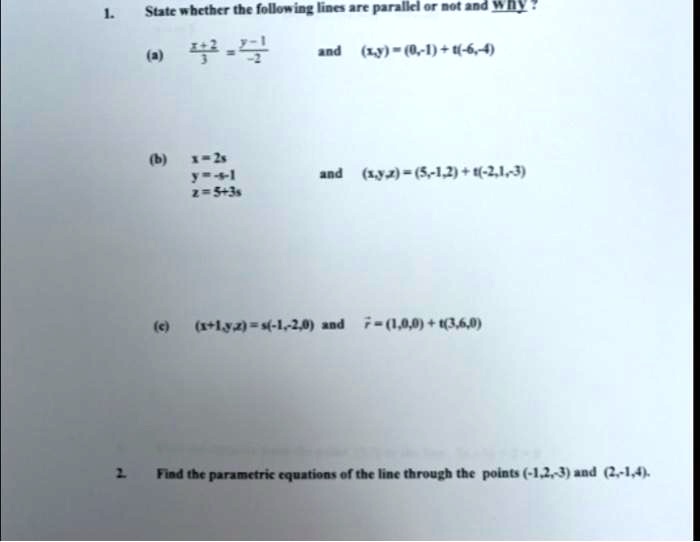
State whether the following lines are parallel or not and why? 1. (a) \frac{x+2}{3} = \frac{y-1}{-2} and $(x,y) = (0,-1) + t(-6,-4)$ (b) $x = 2s$ $y = 4-1$ $z = 5+3s$ and $(x,y,z) = (5,-1,2) + t(-2,1,-3)$ (c) $(x+1,y,z) = s(-1,-2,0)$ and $\vec{r} = (1,0,0) + t(3,6,0)$ 2. Find the parametric equations of the line through the points $(-1,2,-3)$ and $(2,-1,4)$.
View Answer
divider