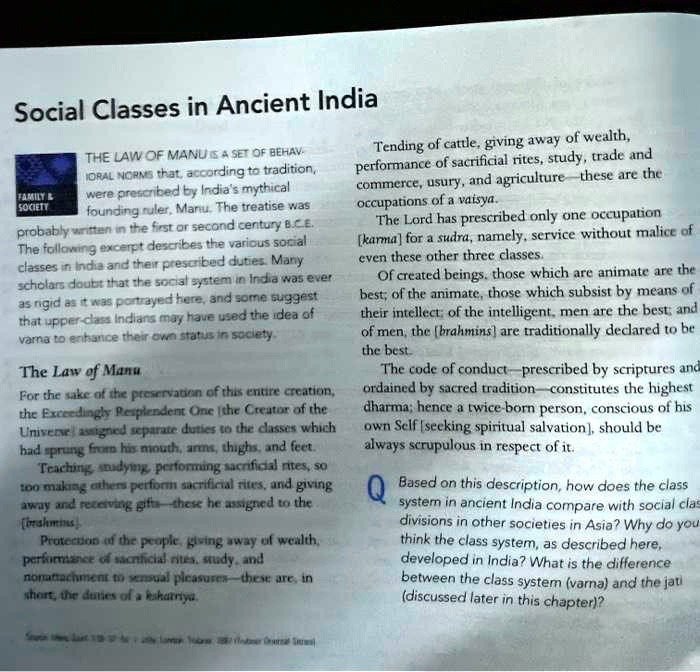
Social Classes in Ancient India"—What kind of tasks are assigned to which class of people in the excerpt provided? Why do you think the specific tasks in this selection are assigned as described? What does this reveal about the nature of class and caste in India? How might such rigid class distinctions have served the purposes of the elites over those of lower classes?
Social Classes in Ancient India: Tending of cattle, giving away of wealth, the law of Manu, set of behaviors, performance of sacrificial rites, study, trade, moral or immoral, commerce, usury, and agriculture—these are the family occupations prescribed by India's mythical society founding ruler, Manu. The treatise was probably written in the first or second century BC [karma] for a sudra, namely service without malice of these other three classes. The following excerpt describes the various social classes in India and their prescribed duties. Many scholars doubt that the social system in India was ever as rigid as it was portrayed here, and some suggest that upper-class Indians may have used the idea of varna to enhance their own status in society. Of created beings, those which are animate are the best of the animate, those which subsist by means of their intellect of the intelligent. Men are the best of men, the [brahmins] are traditionally declared to be the best. The Law of Manu, the code of conduct prescribed by scriptures and ordained by sacred tradition, constitutes the highest dharma. Hence, a twice-born person, conscious of his self, seeking spiritual salvation, should be always scrupulous in respect of it. Teaching, learning, performing sacrificial rites, making others perform sacrificial rites, and giving away and receiving gifts—these are, in short, the duties of a brahmin (discussed later in this chapter).
Based on this description, how does the class system in ancient India compare with social class divisions in other societies in Asia? Why do you think the class system as described here developed in India? What is the difference in the attachment to sensual pleasure discussed later in this chapter?