Learning Goal
To use the method of sections to determine forces in a truss's members.
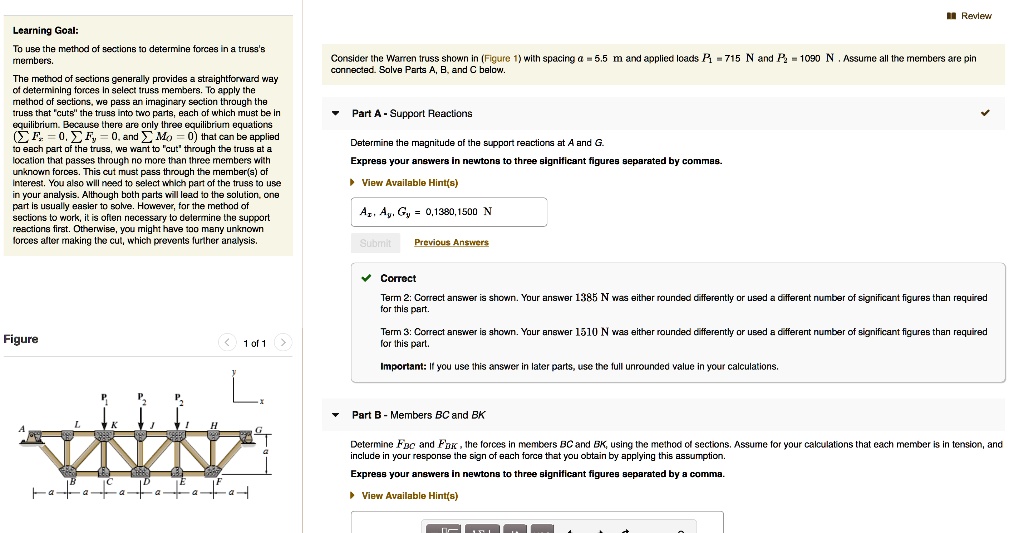
Consider the Warren truss shown in Figure 1 with spacing = 5.5 m and applied loads P = 715 N and P = 1090 N. Assume all the members are pin connected. Solve Parts A, B, and C below.
The method of sections generally provides a straightforward way of determining forces in select truss members. To apply the method of sections, we pass an imaginary section through the truss that cuts the truss into two parts, each of which must be in equilibrium. Because there are only three equilibrium equations (ΣF = 0, ΣFy = 0, and ΣM = 0) that can be applied to each part of the truss, we want to cut through the truss at a location that passes through no more than three members with unknown forces. This cut must pass through the member(s) of interest in your analysis. Although both parts will lead to the solution, one part is usually easier to solve. However, for the method of sections to work, it is often necessary to determine the support reactions first. Otherwise, you might have too many unknown forces after making the cut, which prevents further analysis.
Part A - Support Reactions
Determine the magnitude of the support reactions at A and G.
Express your answers in newtons to three significant figures separated by commas.
A, Ay, Gy = 0, 1380, 1500 N
Previous Answers
Term 2: Correct answer is shown. Your answer 1385 N was either rounded differently or used a different number of significant figures than required for this part.
Figure
Term 3: Correct answer is shown. Your answer 1510 N was either rounded differently or used a different number of significant figures than required for this part.
Important: If you use this answer in later parts, use the full unrounded value in your calculations.
Part B - Members BC and BK
Determine F_BC and F_BK, the forces in members BC and BK, using the method of sections. Assume for your calculations that each member is in tension, and include in your response the sign of each force that you obtain by applying this assumption. Express your answers in newtons to three significant figures separated by a comma.