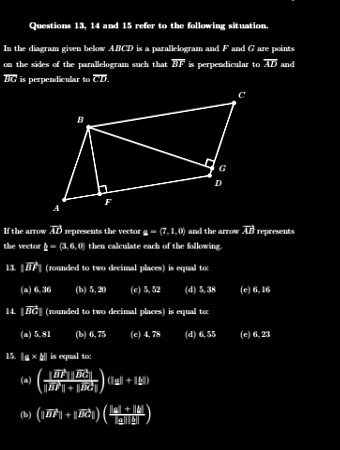
Questions 13, 14 and 15 refer to the following situation.
In the diagram given below ABCD is a parallelogram and F and G are points
on the sides of the parallelogram such that \overrightarrow{BF} is perpendicular to \overrightarrow{AD} and
\overrightarrow{BG} is perpendicular to \overrightarrow{CD}.
B
F
G
D
C
If the arrow \overrightarrow{AD} represents the vector \overrightarrow{g} = (7, 1, 0) and the arrow \overrightarrow{AB} represents
the vector \overrightarrow{b} = (3, 6, 0) then calculate each of the following.
13. $|\overrightarrow{BF}|$ (rounded to two decimal places) is equal to
(a) 6.36 (b) 5.20 (c) 5.52 (d) 5.38 (e) 6.16
14. $|\overrightarrow{BG}|$ (rounded to two decimal places) is equal to
(a) 5.81 (b) 6.75 (c) 4.78 (d) 6.55 (e) 6.23
15. \overrightarrow{b} \times \overrightarrow{g} is equal to:
(a) \left(\frac{|\overrightarrow{BF}|}{|\overrightarrow{BF}| + |\overrightarrow{BG}| }\right)(|\overrightarrow{b}| + |\overrightarrow{g}|)
(b) \left(|\overrightarrow{BF}| + |\overrightarrow{BG}|\right)\left(\frac{|\overrightarrow{b}| + |\overrightarrow{g}|}{|\overrightarrow{b}| + |\overrightarrow{g}|}\right)