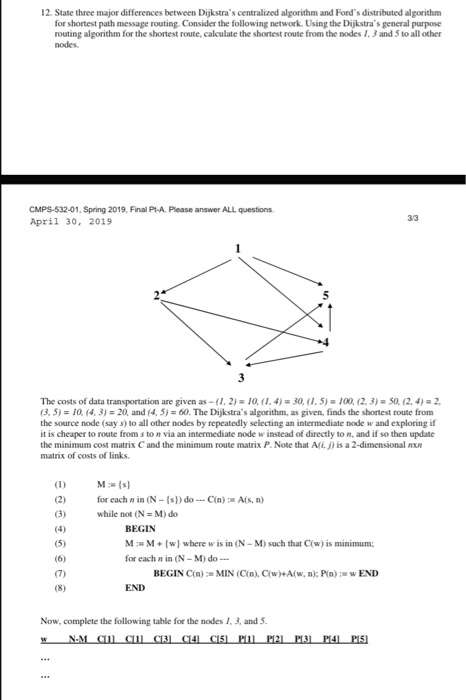
State three major differences between Dijkstra's centralized algorithm and Ford's distributed algorithm for shortest path message routing. Consider the following network. Using Dijkstra's general-purpose routing algorithm for the shortest route, calculate the shortest route from the nodes 1, 3, and 5 to all other nodes.
April 30, 2019
3/3
The costs of data transportation are given as (1, 2) = 10, (1, 4) = 30, (2, 5) = 100, (2, 3) = 50, (2, 4) = 2, (3, 5) = 10, (4, 3) = 20, and (4, 5) = 60. The Dijkstra's algorithm, as given, finds the shortest route from the source node (say s) to all other nodes by repeatedly selecting an intermediate node w and exploring if it is cheaper to route from s to n via an intermediate node w instead of directly to n, and if so then update the minimum cost matrix C and the minimum route matrix P. Note that A(i, j) is a 2-dimensional nxn matrix of costs of links.
(1) (2) (3) (4) (5) (9) (7) (8)
M := {s} for each n in (N - M) do --- C(n) := A(s, n) while not (N = M) do BEGIN M := M + {w} where w is in (N - M) such that C(w) is minimum; for each n in (N - M) do --- BEGIN C(n) := MIN(C(n), C(w) + A(w, n)); P(n) := w END END
Now, complete the following table for the nodes 1, 3, and 5.
..*
...