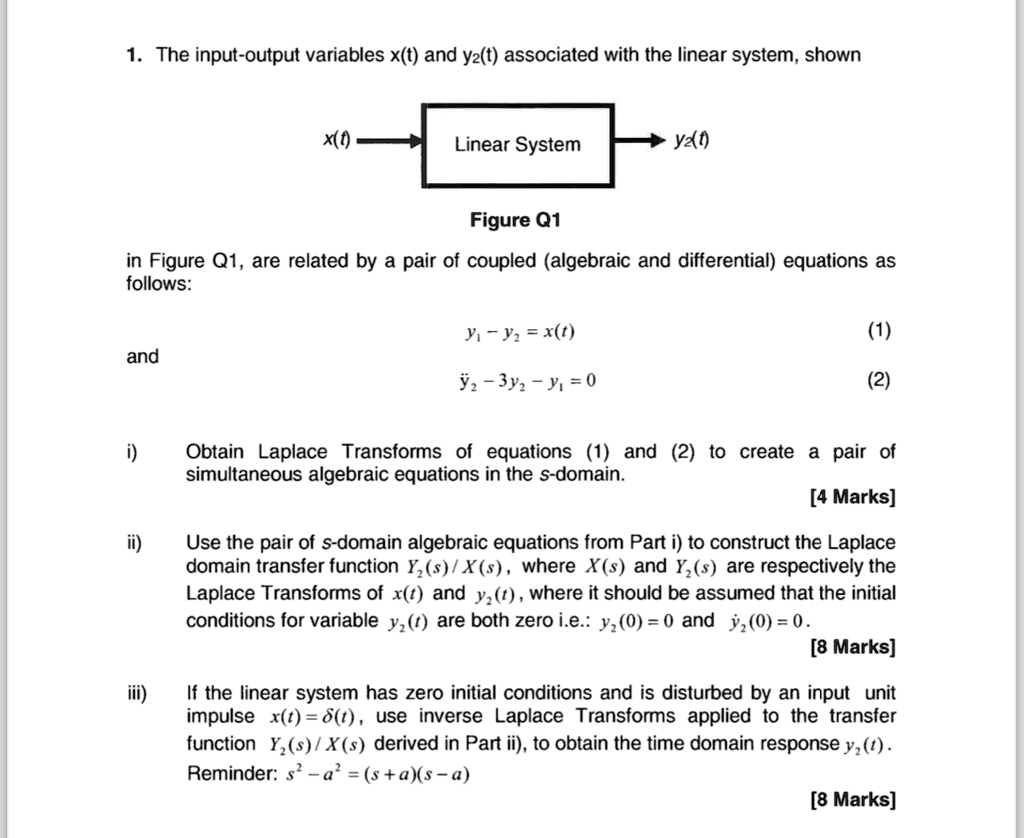
1. The input-output variables x(t) and y2(t) associated with the linear system, shown
x(t)
Linear System
y2(t)
Figure Q1
in Figure Q1, are related by a pair of coupled (algebraic and differential) equations as
follows:
and
i)
ii)
iii)
$$y_1 - y_2 = x(t)$$
$$\dot{y}_2 - 3y_2 - y_1 = 0$$
(1)
(2)
Obtain Laplace Transforms of equations (1) and (2) to create a pair of
simultaneous algebraic equations in the s-domain.
[4 Marks]
Use the pair of s-domain algebraic equations from Part i) to construct the Laplace
domain transfer function $$Y_2(s)/X(s)$$, where $$X(s)$$ and $$Y_2(s)$$ are respectively the
Laplace Transforms of x(t) and y₂(t), where it should be assumed that the initial
conditions for variable y₂(t) are both zero i.e.: $$y_2(0) = 0$$ and $$\dot{y}_2(0) = 0$$.
[8 Marks]
If the linear system has zero initial conditions and is disturbed by an input unit
impulse $$x(t) = \delta(t)$$, use inverse Laplace Transforms applied to the transfer
function $$Y_2(s)/X(s)$$ derived in Part ii), to obtain the time domain response $$y_2 (t)$$.
Reminder: $$s^2 - a^2 = (s+a)(s-a)$$
[8 Marks]