4. Cost-benefit analysis
A local college is deciding whether to conduct a campus beautification initiative that would involve various projects, such as planting trees and
remodeling buildings, to make the campus more aesthetically pleasing.
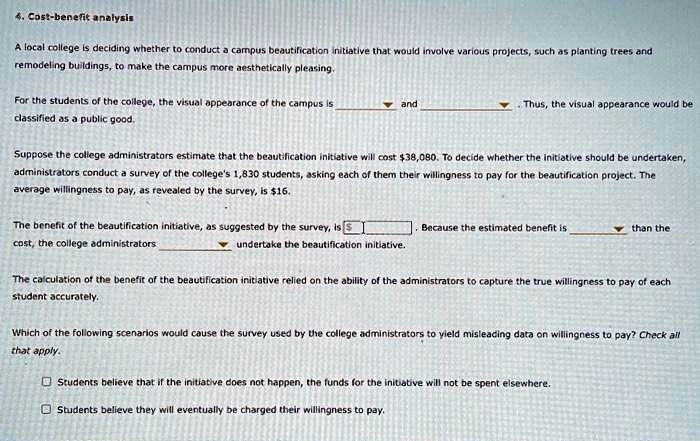
For the students of the college, the visual appearance of the campus is ____ and ____. Thus, the visual appearance would be
classified as a public good.
Suppose the college administrators estimate that the beautification initiative will cost $38,080. To decide whether the initiative should be undertaken,
administrators conduct a survey of the college's 1,830 students, asking each of them their willingness to pay for the beautification project. The
average willingness to pay, as revealed by the survey, is $16.
The benefit of the beautification initiative, as suggested by the survey, is $_____. Because the estimated benefit is ____ than the
cost, the college administrators ____ undertake the beautification initiative.
The calculation of the benefit of the beautification initiative relied on the ability of the administrators to capture the true willingness to pay of each
student accurately.
Which of the following scenarios would cause the survey used by the college administrators to yield misleading data on willingness to pay? Check all
that apply.
\begin{itemize}
\item Students believe that if the initiative does not happen, the funds for the initiative will not be spent elsewhere.
\item Students believe they will eventually be charged their willingness to pay.
\end{itemize}